Okra has a reputation for being effortless in the South. That is only partly true. Once established in real summer weather, it can be durable and productive. But okra seed planted into cold ground can disappear, crowded plants can become miserable to harvest, root-knot nematodes can quietly reduce vigor, and tender pods can turn woody while the gardener waits for them to get “a little bigger.”

Warm soil is the first requirement
Okra, Abelmoschus esculentus, belongs to the mallow family and wants conditions closer to summer than spring. A few warm afternoons do not mean the soil is ready. Cold soil delays germination and increases the chance that seed rots before emergence.
Soaking seed for several hours can soften the seed coat and may speed emergence, but it cannot rescue a cold, saturated bed. The stronger strategy is patience. Plant when night temperatures and soil warmth support continued growth, not when the calendar creates pressure to start everything at once.
In a short season, transplants can provide a head start, but roots should not be held in small cells until they are tangled and stressed. Harden plants carefully and move them after the weather is settled.
Design the row for harvest
An okra row is a place people must enter repeatedly. Plants can become tall, broad, prickly, and difficult to reach through. Spacing therefore controls more than yield. It controls airflow, visibility, and whether pods can be picked every day without breaking branches or missing half the crop.
Follow the packet for the mature habit. Dwarf and compact selections fit tighter systems. Tall branching varieties need more room. Thin seedlings rather than leaving a clump in one planting hole. Several stems competing from one spot do not create several fully productive plants.
Keep a clear path along at least one side. In a wide bed, do not place okra where the center becomes unreachable by midsummer.
Do not feed leaves at the expense of pods
Okra appreciates fertile soil, but excessive nitrogen can create tall soft growth and delay useful pod production. Use compost and fertilizer according to soil conditions rather than feeding automatically every time the leaves look less dark than expected.
Water closely while seedlings establish. Mature plants tolerate short dry periods better than many vegetables, but uneven moisture during flowering and pod growth can reduce production and make pods coarser. Water the root zone deeply. Mulch after the soil is warm to slow moisture loss and reduce weed competition.


Variety changes the harvest rule
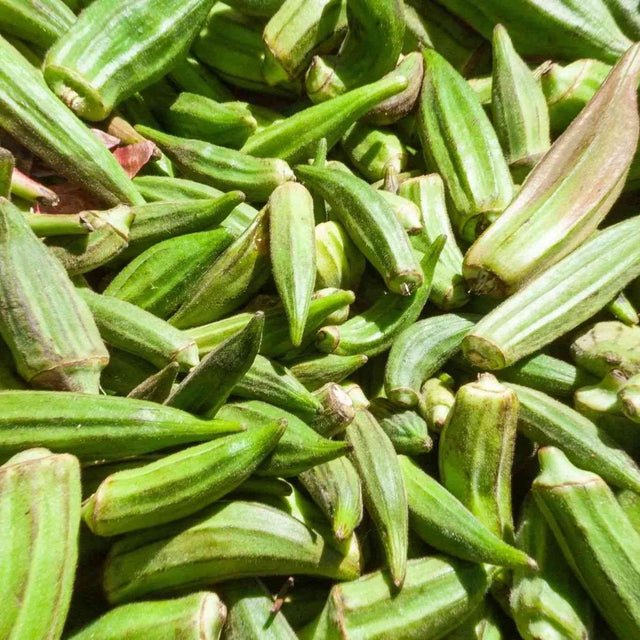
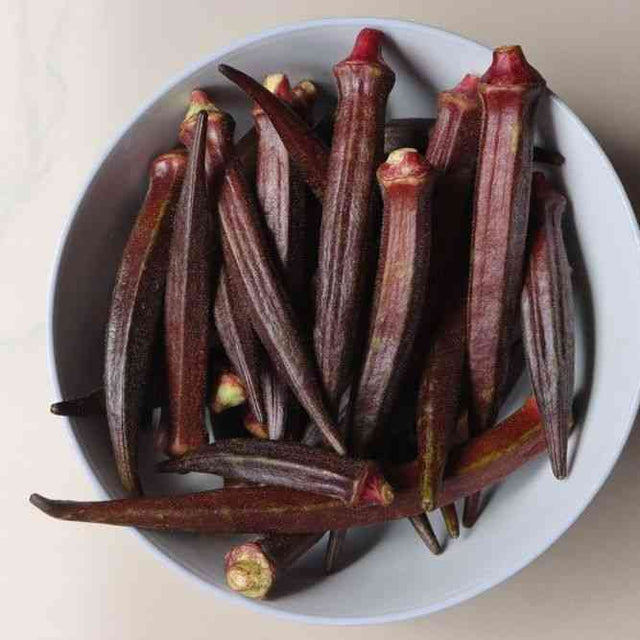
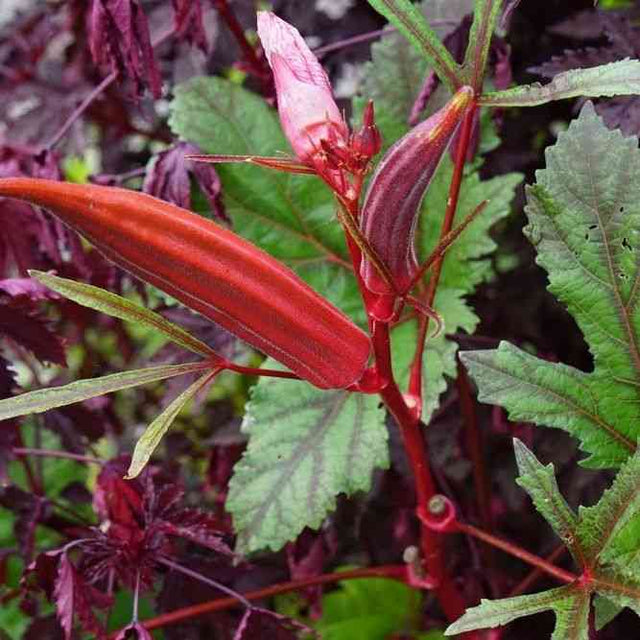
Okra pods differ in color, ribbing, shape, thickness, and the size at which they remain tender. A fixed instruction such as “pick every pod at three inches” is too crude for a diverse okra collection. A round-podded variety may stay tender at a larger size than a strongly ridged type. Some red or orange pods change color when cooked but are still harvested by tenderness.
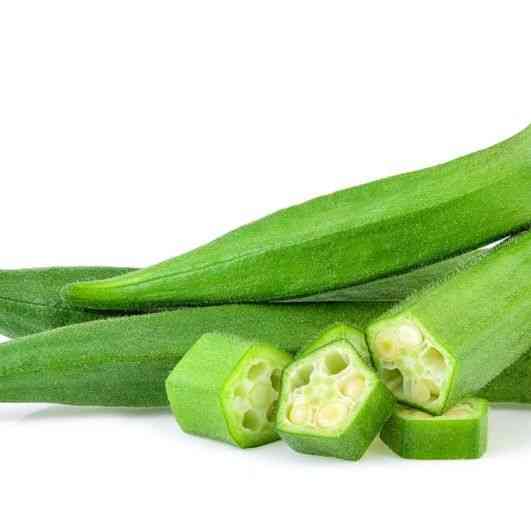
Learn the variety by sacrificing a few pods early in the season. Pick at several sizes, cut them, and compare the fiber. That small test is more useful than letting an entire row become overmature while waiting for an impressive pod length.
Long-pod varieties need a separate test. Perkins Long Pod, Cow Horn, Texas Hill Country Red, and Cherokee Long Pod are selected around elongated pods, but they do not share one universal tender length. Alliance product notes describe Perkins Long Pod around eight inches, Cow Horn at an unusually large curved size, and Texas Hill Country Red around six to eight inches. Treat those figures as starting points. Weather and pod age still settle the matter.


Mark the first few harvests by length and cut across the pod wall. Once the knife starts meeting fiber, shorten the next picking interval. A long-pod name should widen the test, not replace it.

Harvest is the main labor
Once okra starts producing, the crop can outrun a casual harvest schedule. In hot weather, a tender pod can become fibrous in only a few days. Pick every one to two days during peak production.
- Use clippers or a knife rather than snapping heavy pods from the plant.
- Wear sleeves or gloves if the leaves and pods irritate the skin.
- Support the branch when cutting.
- Remove overmature kitchen pods so the plant does not put all its energy into seed.
- Keep intentionally selected seed pods clearly marked so they are not cut by mistake.
Do not confuse “large” with “productive.” The useful harvest is the weight of tender pods the household can actually eat or preserve, not the length of a woody pod left too long.
Read the plant before spraying
Okra can host aphids, stink bugs, caterpillars, Japanese beetles, and other pests. Damage should be identified before treatment. A few chewed leaves on a vigorous plant are not the same problem as distorted new growth, damaged pods, or a colony multiplying on every growing tip.
Look under leaves, inspect buds and pods, and note whether beneficial insects are present. Avoid broad insecticide use during flowering unless the pest and treatment threshold justify it. Okra flowers attract pollinators, and unnecessary spraying can turn a manageable pest into a larger ecological problem.
Root-knot is a soil-history problem
Okra can grow poorly in soil infested with root-knot nematodes. Symptoms above ground can look vague: stunting, yellowing, wilting in heat, and reduced production. The clearer sign is below ground. Infected roots develop swollen galls rather than normal fine roots.
If root-knot is suspected, lift one declining plant with its roots intact. Do not simply add fertilizer to a root system that cannot function. Rotation, resistant or poor-host crops, sanitation, organic matter management, and other controls need to be planned across seasons. Moving infested soil on tools or transplants can spread the problem to clean beds.
Late-season decisions
In a long Southern season, healthy okra may produce until cool weather. Tall plants damaged by wind or growing beyond comfortable reach can sometimes be cut back in a long season, but that decision only makes sense if enough warm weather remains for regrowth. Do not prune heavily simply because the plant is tall. First ask whether the remaining season can repay the setback.
When production slows because nights cool, harvest the remaining tender pods and decide which marked pods will mature for seed.


Save seed on purpose
Seed pods must remain on the plant until they are fully mature and dry. They become large, hard, and inedible. Mark them early so the harvest crew knows they are reserved.
Okra can cross between varieties. Separate seed plantings when preserving named lines, or control pollination where purity matters. Save from several healthy, productive plants that match the variety. Let pods dry thoroughly, shell carefully, remove damaged seed, label the lot, and store only when the seed is dry.
The stronger okra strategy
Okra belongs in the part of the garden calendar where cool-season crops have surrendered. Give it heat, room, and a harvest path. Plant enough to supply the kitchen, but not so much that the row cannot be picked every other day. Choose varieties for pod use and plant habit, not only color. Reserve seed pods intentionally. Inspect roots when decline has no obvious above-ground cause.
That turns okra from a tall novelty into a dependable summer crop.