
Powdery mildew looks dramatic because the fungus grows where we can see it: across the leaf surface in white patches that may join into a gray film. It rarely begins as a sudden white blanket. The first small colonies are the moment when identification and action matter most.
The disease is not simply proof that the garden was watered overhead. Different powdery mildew fungi thrive under their own conditions, and some spread when leaves are dry but humidity is high.
A cucumber leaf with natural silver mottling is not automatically diseased. Rub, inspect, compare new and old leaves, and look for expanding powdery colonies before starting a spray program.
Confirm powdery mildew before treating
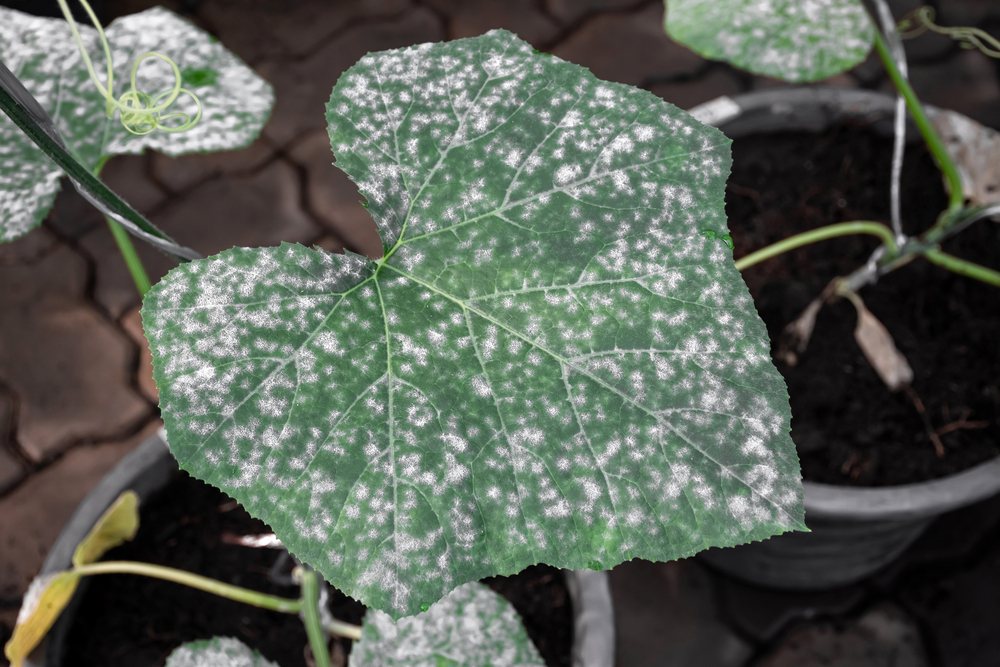
Powdery mildew usually appears as white to gray, talc-like patches on upper or lower leaf surfaces, petioles, or stems. Patches expand and older leaves may yellow, curl, or die early.
On cucurbits, compare suspicious white areas with the normal silver pattern of the variety. True mildew often looks superficial and irregular, while natural markings follow the leaf’s pattern.
- Inspect the oldest shaded leaves first.
- Look for new colonies on both leaf surfaces.
- Check whether the white material expands from week to week.
Read the pattern, not one damaged leaf
The disease is favored by susceptible varieties, crowded canopies, shade, and humid air around leaves. Unlike many leaf diseases, free water on the leaf surface is not always required for infection.
Late-season mildew on a mature squash vine may have less economic importance than an early outbreak on a young plant that still needs weeks of healthy leaf area.
| What you see | What it suggests | What to check next |
|---|---|---|
| White powder that wipes or smears | Powdery mildew likely | Look for expanding colonies on nearby leaves |
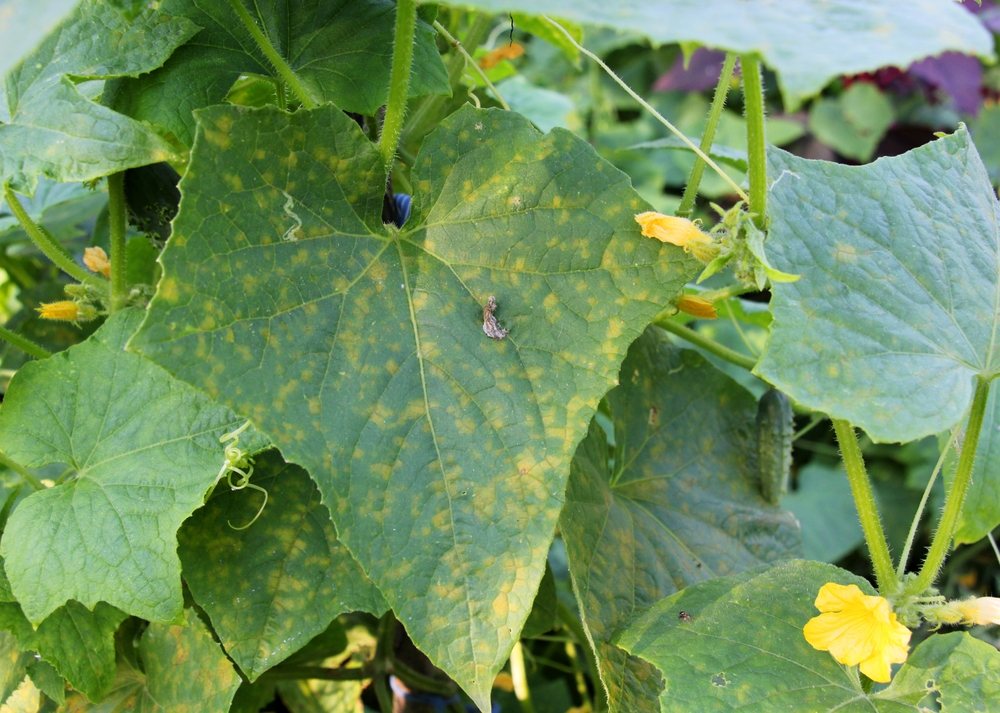
| Angular yellow lesions limited by veins | Downy mildew or another foliar disease | Inspect leaf undersides and seek crop-specific diagnosis |
| Fixed silver pattern on squash leaves | Normal varietal marking possible | Compare several healthy leaves and the variety description |
| White residue after spraying | Spray deposit | Check untreated leaves and whether the material changes over time |
Start with the least disruptive correction
Remove a few heavily infected leaves only when the plant can spare them. Improve spacing, reduce dense weeds, and direct irrigation to the soil.
- Choose resistant varieties when available.
- Plant in adequate sun and avoid excessive nitrogen.
- Begin any labeled fungicide or oil program before the canopy is overwhelmed.
- Alternate active ingredients when the label and local guidance call for resistance management.
Protect the crop while the garden recovers
Late rescue sprays rarely restore dead leaf tissue. The goal is to protect healthy leaves, not turn old ones green again.
Excessive pruning can expose fruit to sunscald and reduce the plant’s remaining energy.
- Do not spray oils in intense heat or close to sulfur applications.
- Do not compost heavily diseased leaves unless the compost is managed hot.
- Do not reuse a home remedy across crops without checking phytotoxicity.
Use weather and season as part of the diagnosis
In humid Mid-Atlantic summers, dense cucurbit and zinnia plantings can develop mildew quickly once nights become longer and airflow slows. Coastal humidity can extend pressure, while mountain nights may favor disease even when days feel dry.
Start scouting before the usual late-summer outbreak, especially on squash, cucumbers, zinnias, bee balm, and other susceptible crops.
Know when the problem needs a different answer
If symptoms spread despite reasonable cultural correction, confirm the disease before choosing a fungicide. Downy mildew, bacterial leaf spots, nutritional injury, and natural leaf markings need different responses.
Seek local guidance for commercial production, severe outbreaks, resistant disease populations, or crops with strict harvest intervals.
The label determines which crop, disease, rate, interval, and temperature conditions are legal and safe.
Put this guide to work in a real garden
Put this guide beside the plant, not just beside the computer. Begin with one affected specimen and compare it with a healthy plant of the same kind. Record where the symptoms begin, whether the newest growth is changing, and what insects or fungal signs are actually present. With powdery mildew, the pattern is usually more useful than the most dramatic leaf.
Work in a fixed order: identify, measure, correct the growing condition, then decide whether direct control is justified. That order matters because a stressed plant can carry several secondary symptoms at once. A treatment chosen from one photograph may remove a visible insect while leaving the irrigation, crowding, fertility, or seasonal problem untouched.
Recheck the same plant after two or three days and again after a week. Photograph the same leaf or stem from the same angle. The point is not to make the garden look perfect overnight. It is to know whether the crop is recovering, holding steady, or continuing to lose ground.
- Mark the affected plant and the date.
- Inspect the upper and lower leaf surfaces, stems, crown, and nearby soil.
- Note recent rain, irrigation, heat, fertilizer, transplanting, or pruning.
- Choose the least disruptive correction that addresses the confirmed cause.
- Return on a scheduled date instead of treating repeatedly from anxiety.
Use a 30-day checkpoint instead of guesswork
Day 0: establish the baseline
Photograph the whole plant and the closest clear symptom. Count how many plants are affected and mark the edge of the problem.
Day 3: look for direction
Check new growth rather than staring only at old damage. Note whether pests, spores, wilting, or discoloration are expanding.
Day 7: judge the correction
Compare treated and untreated areas when practical. A successful correction slows new injury even though damaged tissue may remain.
Day 14: decide the next level
Continue, stop, or escalate based on evidence. Do not repeat a pesticide simply because the calendar says another application is possible.
This guide cannot identify every disease, insect, nutrient disorder, or herbicide injury from a photograph. When symptoms are severe, unusual, rapidly spreading, or tied to a valuable perennial crop, use a local extension diagnostic service or qualified laboratory.
Keep a one-season record
The record does not need to be elaborate. A notebook page, spreadsheet row, or labeled photograph is enough when it captures the variables that matter.
- Host plant and cultivar
- First symptom and plant part affected
- Weather and watering during the previous week
- Natural enemies, eggs, larvae, spores, or residue observed
- Action taken and what changed afterward
Write enough that another grower—or you, one year later—could understand what was planted, what happened, and why the next decision changed.
Questions gardeners ask
Does powdery mildew need wet leaves?
Many powdery mildew fungi can infect without free water on leaves. Humid air, susceptible tissue, and moderate temperatures can be enough.
Should I remove every infected leaf?
No. Remove only what the plant can spare. Stripping a vine can reduce yield and expose fruit to sun.
Can powdery mildew spread between every plant species?
Powdery mildew fungi are often host-specific or limited to related plants. A mildew on squash is not necessarily the same organism on a nearby flower.
Will milk cure powdery mildew?
Milk sprays have shown variable results in some settings, but they are not a universal cure. Crop-labeled products and resistant varieties are more predictable.
Can I save seed from a mildewed plant?
Many powdery mildews are not seedborne, but severe disease can reduce seed maturity and vigor. Save only fully mature seed from otherwise healthy plants and follow crop-specific guidance.
Powdery mildew is easiest to manage while it is still a few pale islands on a green leaf. Once it becomes the whole map, the season is already making the decision for you.


