A curled tomato leaf can make a gardener feel like the plant is sending an emergency signal. Sometimes it is. Sometimes the plant is simply folding its leaves in response to heat, dry soil, fast growth, or pruning.
The phrase "tomato leaf curl" describes a symptom, not one disease. Aphids, viruses, herbicide injury, physiological leaf roll, root stress, and environmental conditions can all curl or distort leaves in different ways.
The useful question is not only, "Are the leaves curled?" It is, "Which leaves, in what direction, with what texture, color, pattern, and effect on the rest of the plant?"
Leaf curl is a shape. Diagnosis comes from the rest of the pattern.
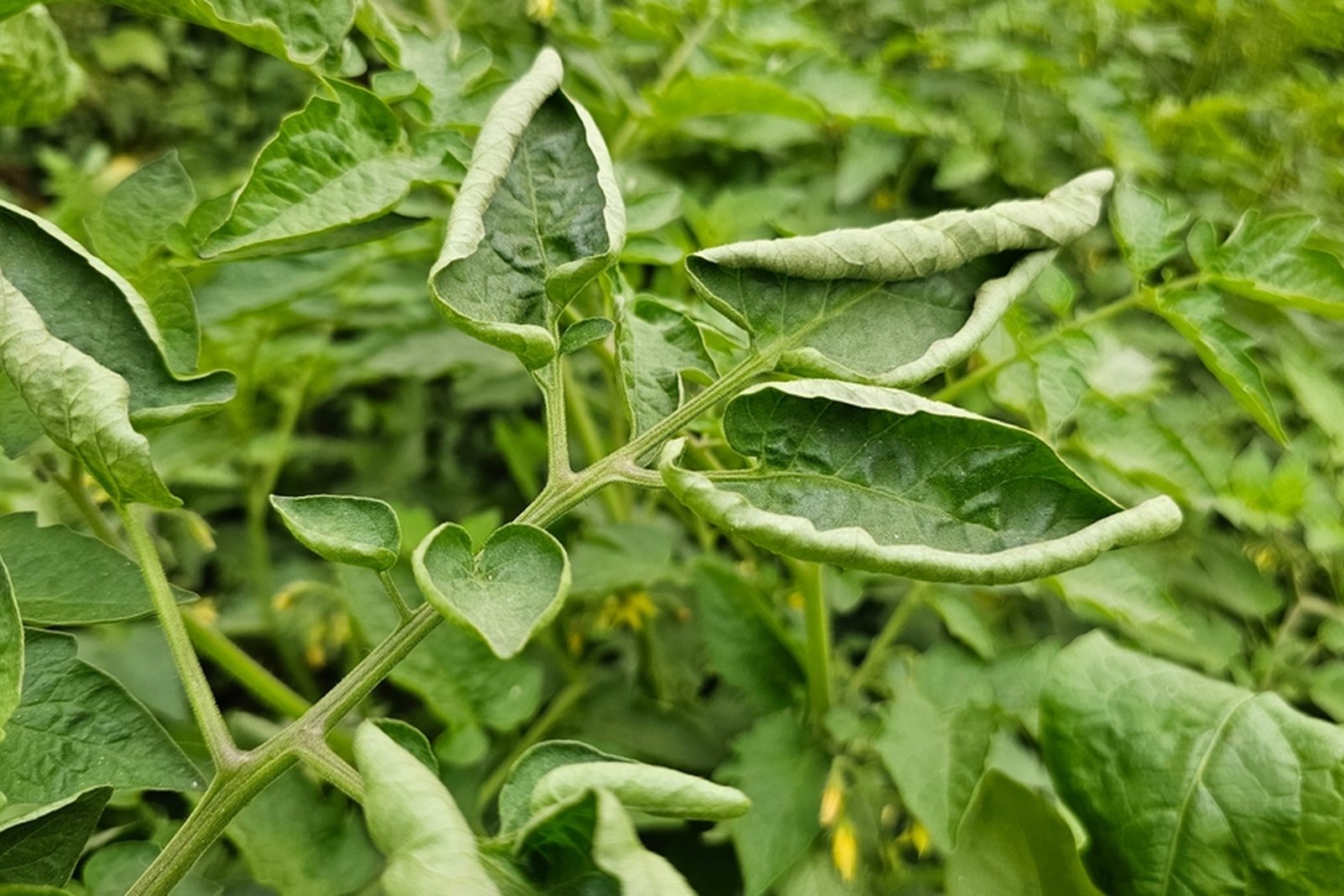
A leaf-curl diagnosis starts with five observations
Do not spray, fertilize, or remove the plant until the symptom pattern is clear. Many curled plants are responding to heat, water, root disturbance, pruning, or container stress rather than a contagious disease.
| Field measure | Practical starting point | How to use it |
|---|---|---|
| Leaf age | Old leaves, new leaves, or both | Physiological roll often affects older leaves. Viruses and herbicide injury often distort the newest growth. |
| Direction | Upward roll, downward curl, cupping, twisting, or narrow strap-like leaves | Direction and shape help separate water stress, pests, virus, and chemical injury. |
| Plant distribution | One leaf, one plant, a row edge, or the whole planting | A row-edge or downwind pattern suggests a different cause than uniform heat stress. |
| Growth effect | Normal new growth versus stunting and shortened internodes | Physiological leaf roll often leaves growth and yield largely intact. Severe virus or herbicide injury can stop normal growth. |
| Color | Normal green, yellow mosaic, bronzing, or scorched tissue | Yellow distorted new growth raises concern for virus, root injury, nutrient stress, or chemical injury. |
| Insects | Check leaf undersides and growing tips with magnification | Aphids, whiteflies, mites, and their cast skins or honeydew provide direct evidence. |
| Root-zone history | Dry, saturated, hot, compacted, recently transplanted, or root-pruned | Root stress can cause rolling even when the leaves are not visibly wilted. |
| Recovery test | Observe 24 to 72 hours after correcting water or heat stress | Improving new growth supports an environmental cause. Progressive distortion needs further diagnosis. |
Physiological leaf roll commonly appears as upward rolling or inward cupping of older leaves. The leaves may remain green and firm, and the plant may continue flowering and fruiting. Heat, drought, excess moisture, root injury, hard pruning, and rapid growth can contribute.
Virus symptoms usually involve more than simple rolling. Look for yellowing, mosaic, stunted plants, small distorted new leaves, shortened internodes, and a pattern linked with whiteflies or other vectors. Confirm through Extension or a diagnostic lab before making a virus claim.
Herbicide injury often distorts the newest growth. Leaves may become narrow, twisted, cupped, fern-like, or strap-shaped. The pattern may be strongest on a field edge, downwind side, one branch, or plants exposed to contaminated compost, manure, mulch, or spray equipment.
Five-minute field check
- Photograph the whole plant and both sides of affected leaves.
- Compare old growth with the newest growth.
- Inspect at least five nearby plants and note the edge or wind pattern.
- Check soil moisture below the surface and inspect container drainage.
- Look for aphids, whiteflies, mites, honeydew, cast skins, and feeding damage.
- Write down pruning, fertilizer, pesticide, herbicide, and weather events from the previous two weeks.
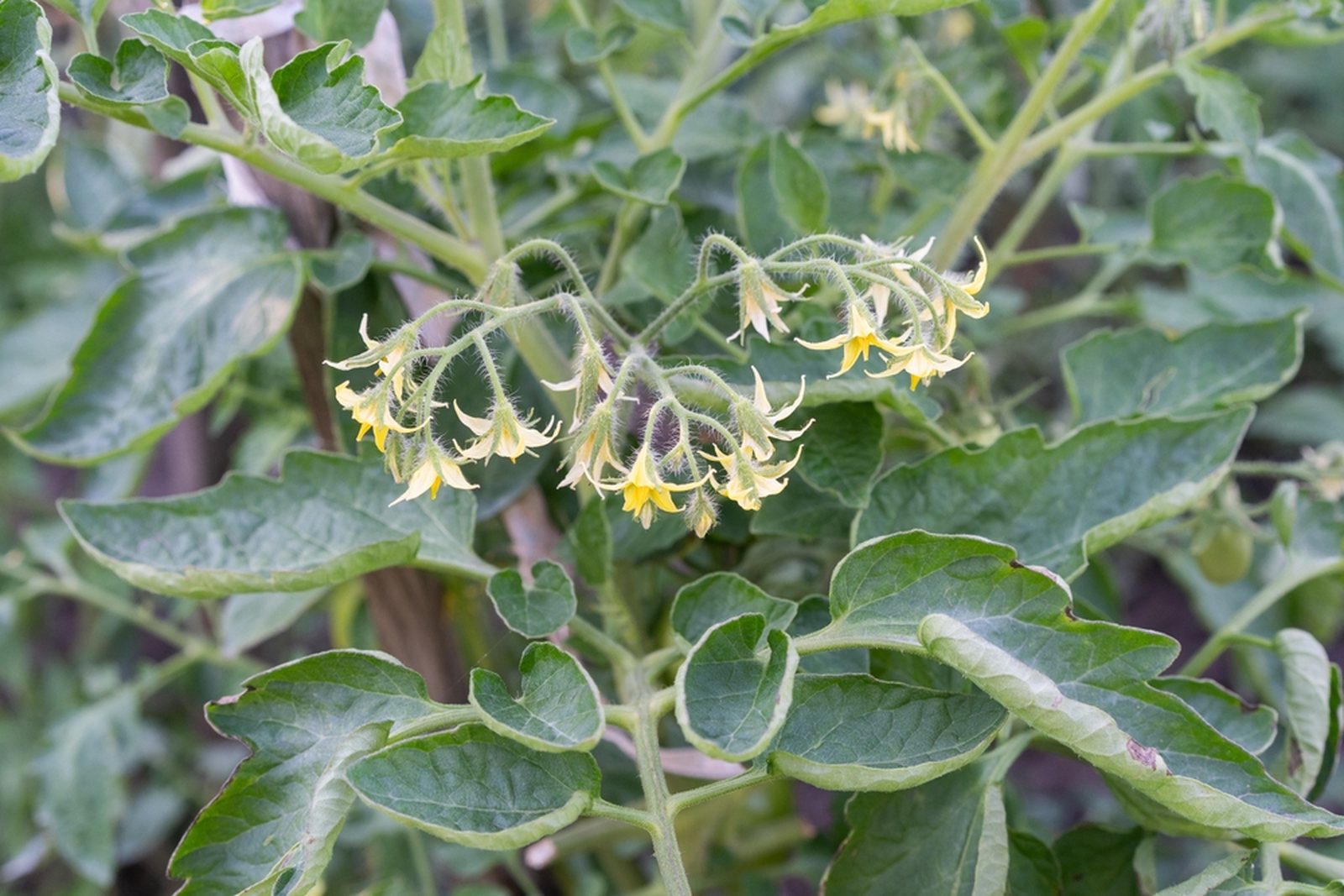
Important: The flower-cluster photograph in this guide also shows upward-rolled leaves. It should be read as a stress symptom, not labeled as a normal healthy leaf posture.
The first five things to inspect
- Old or new growth? Lower mature leaves rolling differs from twisted new tips.
- Firm or limp? Thick leathery roll differs from wilt.
- Green or mottled? Normal color differs from mosaic or yellowing.
- Whole plant or one side? One-sided injury suggests drift or local damage.
- Fruit and growth normal? Stunting and fruit rings raise concern beyond physiological roll.
Physiological leaf roll
University of Minnesota describes physiological leaf roll as firm, leathery leaves curling upward and inward, often beginning low on the plant. Heat, dry weather, fast growth, and pruning can contribute.
The rolled leaves generally do not unroll later, but the disorder usually does not reduce growth or yield noticeably. Some varieties show it more readily, especially in protected structures.
Management is simple: reduce stress, maintain steady moisture, avoid excessive pruning, and do not apply unnecessary treatments.
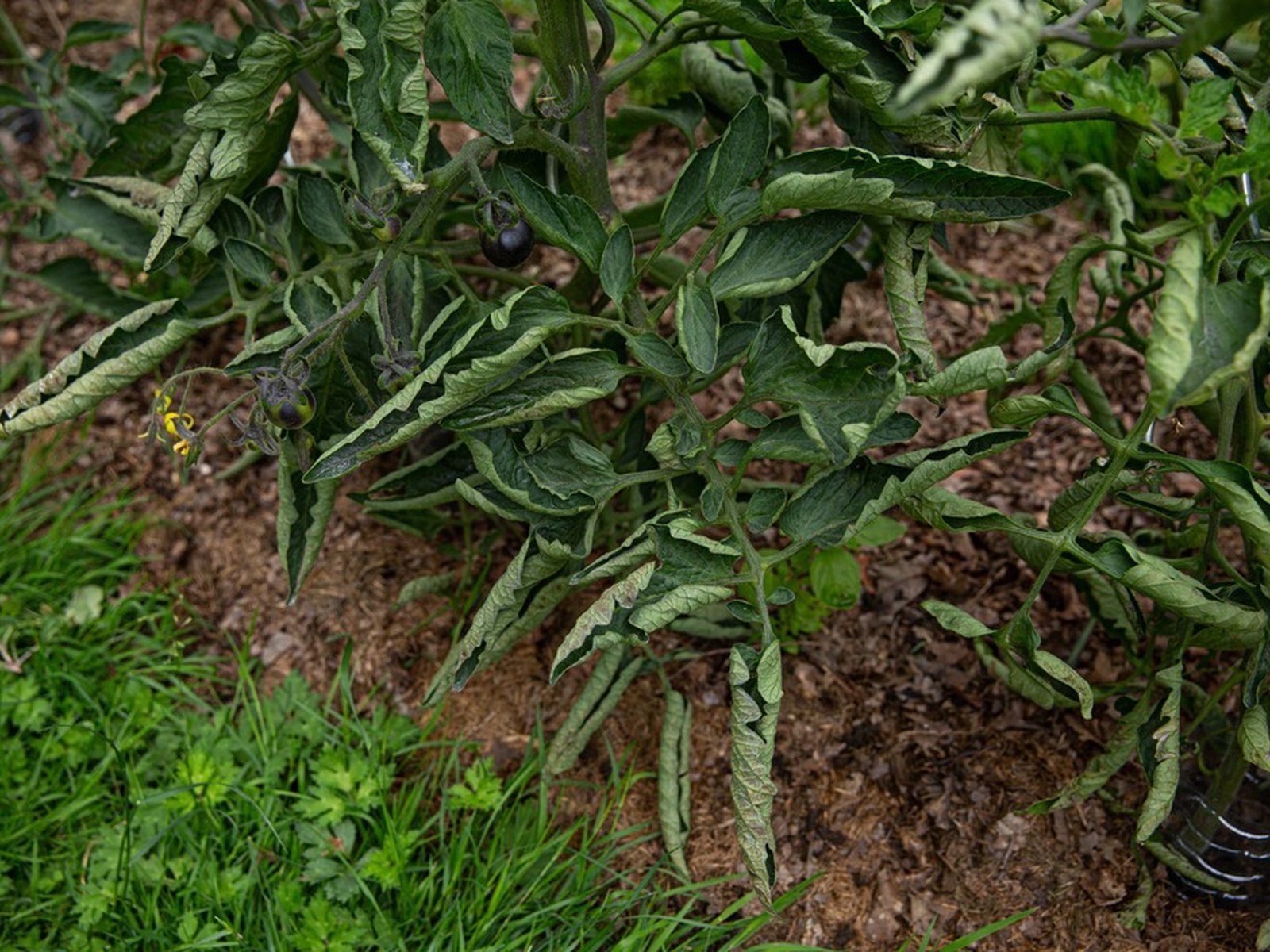
Water and root stress
Both drought and saturated soil can curl leaves. Drought reduces water supply; waterlogging deprives roots of oxygen. Container tomatoes can move between these extremes in one week.
Check moisture below the surface rather than judging by the top inch. Look for root restriction, compacted soil, damaged roots, or a container too small for the plant.
Mulch and deep consistent watering help prevent the repeated dry-wet cycle that also contributes to fruit cracking.
Aphids and other insects
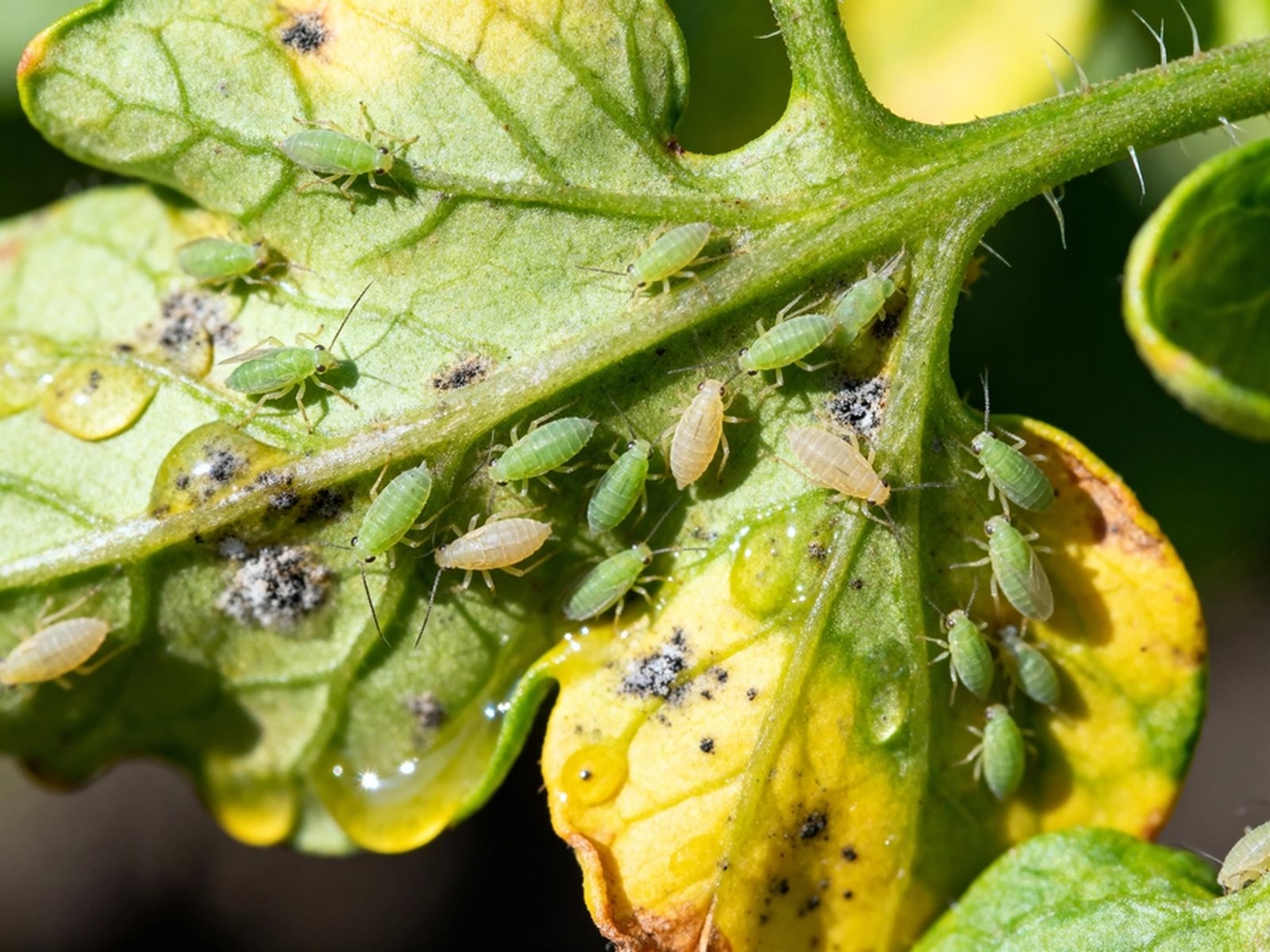
Aphids cluster on tender growth and leaf undersides. Heavy feeding can cause curling, stunting, and sticky honeydew. Look for live insects, shed skins, ants, and distorted young tissue.
Whiteflies and mites can also distort or discolor leaves. Identify the pest before choosing a treatment. Beneficial insects often control light aphid populations.
Virus symptoms need a wider pattern
Viruses may cause mottling, yellow-green patterns, shoestring leaves, severe distortion, rings on fruit, and stunting. Symptoms often affect new growth and the whole plant rather than producing firm healthy-colored leaf roll alone.
There is no home cure for a virus-infected plant. Remove suspect plants if confirmed, control insect vectors, sanitize tools, and manage weeds that can host viruses.
Herbicide drift and contaminated materials
Herbicide injury often affects new growth: leaves become twisted, cupped, narrow, strapped, or unusually veined. The side facing a treated lawn or field may be worse.
Sources include spray drift, volatilization, contaminated compost or manure, and equipment previously used for herbicides. Do not diagnose herbicide injury solely from curl; map the exposure and compare neighboring sensitive plants.
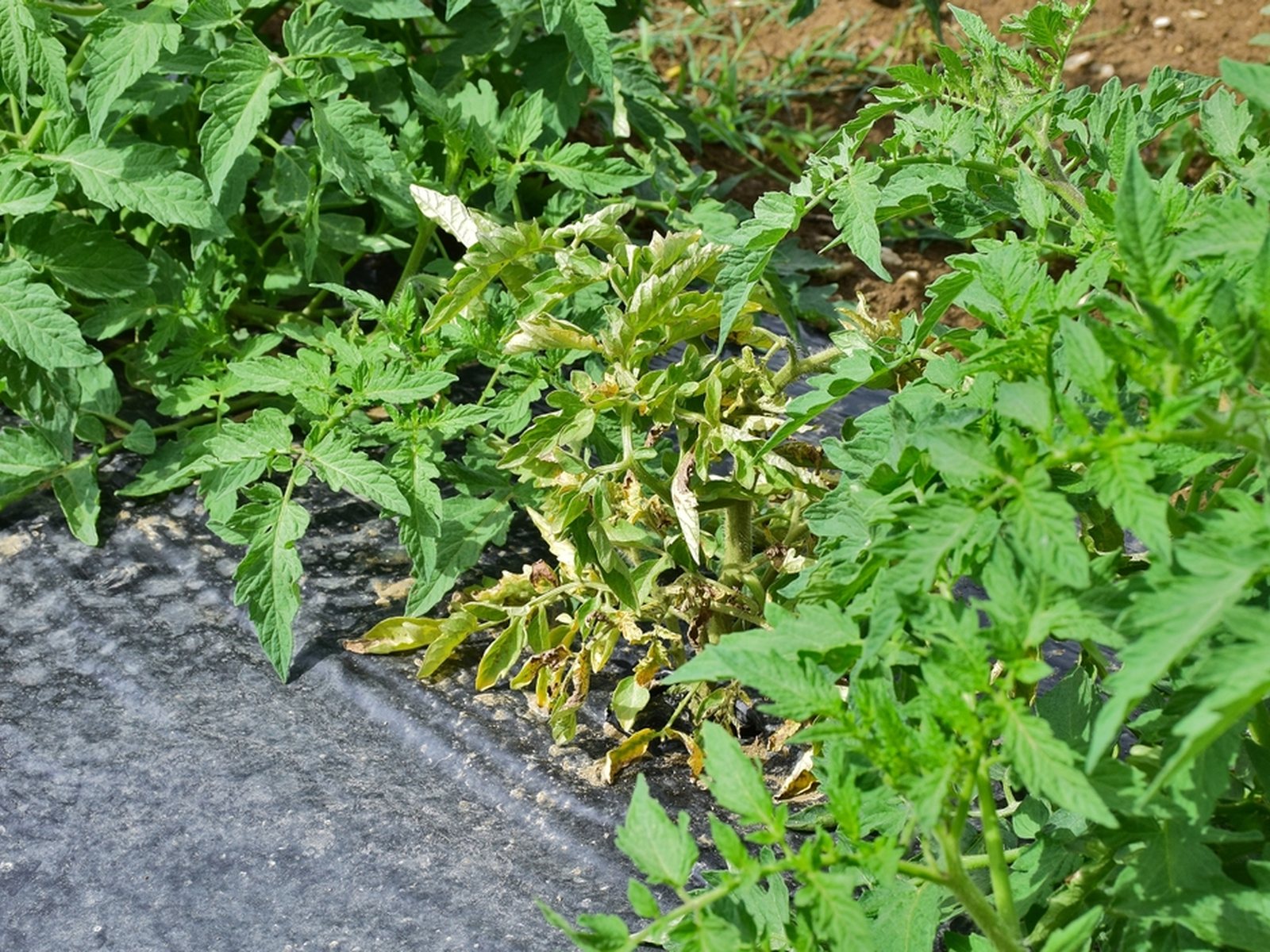
Heat, fast growth, and pruning
Hot dry weather increases leaf roll, and heavy pruning can trigger or worsen it. A plant with much of its canopy removed has fewer leaves to regulate water and shade fruit.
Prune gradually and preserve enough canopy. Avoid combining transplant shock, root disturbance, fertilizer surge, drought, and aggressive pruning in the same week.
A practical decision path
- Firm green lower leaves, normal growth: likely physiological roll; reduce stress.
- Limp plant and dry soil: water deeply and reassess.
- Limp plant and wet soil: investigate root oxygen and disease.
- Live aphids or mites: manage the identified pest.
- Mottled, stunted, distorted new growth: seek virus diagnosis.
- Twisted one-sided new growth near spraying: investigate herbicide exposure.
- Spots, lesions, or stem damage: use a disease diagnostic rather than a leaf-curl guide.
When to contact Extension or a diagnostic lab
Seek help when symptoms spread quickly, several crops are affected, new growth is severely distorted, fruit shows rings or mottling, the plant is stunted, or herbicide contamination may affect compost or manure used across the garden.
Photograph the entire plant, both leaf surfaces, stems, fruit, and nearby unaffected plants. Record weather, watering, fertilizer, herbicide use, and symptom timing.
Leaf-curl symptom comparison
| Pattern | More consistent with | What to inspect next |
|---|---|---|
| Firm green lower leaves roll upward | Physiological leaf roll | Heat, drought, pruning, cultivar tendency |
| Whole plant wilts, soil dry | Water shortage | Root-zone moisture and container volume |
| Whole plant wilts, soil wet | Root oxygen or root disease | Drainage, roots, stem base |
| Tender tips crowded with insects | Aphids or whiteflies | Leaf undersides, honeydew, ants |
| New leaves twisted or strap-like | Herbicide exposure | Drift direction, compost, manure, sprayer history |
| Mottling, yellowing, stunting | Virus or systemic disease | Whole plant, vectors, nearby hosts |
| Curl plus spots or lesions | Foliar disease | Diagnostic guide for the lesion pattern |
Do not force a diagnosis from one feature. The most useful clue is often where the symptom began and what changed immediately before it appeared.
A 24-hour observation check
Before applying anything, make one careful round of observations:
- Feel the soil four to six inches deep.
- Compare the affected plant with the healthiest plant nearby.
- Look under leaves with a hand lens.
- Photograph the newest growth and the oldest affected leaf.
- Review the previous week’s heat, wind, rain, fertilizer, pruning, and spraying.
- Check whether peppers, beans, grapes, or other sensitive plants show similar distortion.
Many physiological problems become clearer after one day of corrected watering and reduced stress. Herbicide, virus, and pest problems usually continue showing a distinct pattern.
Why container tomatoes curl more often
Containers amplify temperature and water swings. A black pot in full sun can heat the root zone, dry rapidly, and then become saturated by a heavy watering. Roots may also fill the container long before the gardener expects.
For container tomatoes:
- Use enough soil volume for the mature variety.
- Mulch the surface.
- Water deeply rather than giving repeated shallow splashes.
- Confirm excess water can leave the pot.
- Shade the container wall in extreme heat if roots are overheating.
- Do not let a saucer hold stagnant water for long periods.
If leaves curl while fruit set and new growth remain normal, the plant may be signaling stress rather than a contagious disease.
A five-minute field check before treating leaf curl
Before spraying or fertilizing a curled plant, look at the pattern. Is the curl on old leaves, new leaves, one side of the plant, every plant in the row, or only the plant beside a driveway or treated lawn? Are leaves still green and flexible, or are they twisted, yellow, mottled, bronzed, sticky, or covered with insects? Is the plant setting fruit normally?
- Check soil moisture several inches below the surface rather than judging the dry top crust.
- Review the last week of heat, wind, heavy rain, pruning, transplanting, and chemical use nearby.
- Inspect the undersides of young leaves with a hand lens for aphids, mites, whiteflies, and eggs.
- Compare new growth with older growth. Viral or herbicide injury often distorts the growing point more than ordinary physiological roll.
- Check neighboring plant species. Similar distortion across unrelated plants can point toward drift or contaminated compost rather than a tomato-specific disease.
Physiological leaf roll usually affects otherwise green leaves and often follows heat, pruning, water stress, or rapid growth. It can remain for the season without destroying the crop. Severe twisting of new growth, narrow strap-like leaves, unusual branching, yellow mosaic, stunting, or a spreading pattern requires a different response and may justify Extension diagnosis.
Avoid stacking corrections. A stressed plant does not benefit from extra fertilizer, repeated watering, insecticidal soap, and aggressive pruning applied on the same day. Correct the clearest cultural problem, observe new growth, and document the result. New leaves tell you whether the plant is recovering; old curled leaves may never flatten completely.
Treat the cause, not the curl
A curled leaf does not need to be removed merely because it is curled. Keep green functioning leaves unless they are diseased, badly damaged, or blocking necessary access. Correct the root-zone or environmental problem and watch the new growth.
| What you observe | Most useful next check | Action that follows the evidence |
|---|---|---|
| Older leaves roll upward; new growth is normal | Check heat, water, pruning, root injury, and container size | Stabilize the root zone and monitor. Avoid unnecessary pesticide or fertilizer. |
| New growth is yellow, twisted, and stunted | Inspect insects and exposure history; contact Extension | Isolate the plant if virus is plausible and seek confirmation. |
| Several plants on one edge show strap-like growth | Review wind direction, herbicide use, compost, manure, and spray equipment | Stop the suspected exposure and document the pattern. Do not compost severely contaminated tissue into sensitive beds. |
| Leaves curl with visible aphids and honeydew | Confirm the insect and the scale of the infestation | Use the least disruptive labeled control and preserve beneficial insects when possible. |
Why tomato leaves curl: begin with the pattern
This guide answers why tomato leaves curl by diagnosing the whole plant rather than the shape of one leaf. It separates physiological tomato leaf roll, tomato leaves curling up after stress, aphids on tomato leaves, tomato yellow leaf curl virus clues, herbicide damage tomatoes may show, and a practical tomato leaf curl diagnosis.
Tomato leaf curl is a symptom, not one disease. The first question is not "what should I spray?" It is where the curl appears, which leaves are affected, whether growth is distorted, and whether the plant is stunted.
| Pattern | Common possibilities | Most useful next check |
|---|---|---|
| Older lower leaves roll upward but remain green and firm | Physiological leaf roll from heat, pruning, moisture stress, or cultivar tendency | Check soil moisture, recent pruning, heat, and whether new growth is normal |
| Entire plant wilts or rolls with wet soil | Low root oxygen, root disease, vascular wilt | Inspect drainage, roots, and stem vascular tissue |
| New leaves are twisted, narrow, cupped, or fernlike | Herbicide injury, virus, broad mites, or severe environmental injury | Review exposure pattern and inspect with magnification |
| Leaves curl with sticky residue and insects underneath | Aphids or whiteflies | Inspect lower leaf surfaces and growing tips |
| Leaves curl with yellow mosaic, shortened internodes, and stunting | Virus-like disease | Compare neighboring plants and seek diagnostic confirmation |
| Only container plants curl during afternoon heat | Root-zone heat and rapid dry-down | Check pot temperature, volume, and moisture depth |
| One side of a row shows distorted new growth | Spray drift or contaminated input | Map wind direction, compost, manure, mulch, and application history |
The same leaf may roll after several stresses. Do not diagnose from one curled edge without looking at the whole plant and the whole planting.
Physiological tomato leaf roll
Physiological leaf roll usually affects older lower leaves. Leaflets roll upward and may become thick, stiff, or leathery. Missouri Extension notes that it is especially common on trained and pruned plants and generally does not reduce yield. Heat, water stress, rapid growth, root disturbance, and cultivar tendency can contribute.
The plant in the flower-cluster photograph used in this guide shows visible upward rolling of lower leaves. It should not be labeled as simply healthy foliage. The flowers may still be functional, but the leaf pattern is evidence of physiological stress.
What to do
- Check moisture several inches below the surface.
- Review whether roots recently went from dry to saturated.
- Stop unnecessary pruning.
- Protect container roots from afternoon heat.
- Maintain mulch and steady irrigation.
- Observe new growth for one to two weeks.
If new growth remains normal, the plant is not stunted, and no yellow mosaic or severe distortion develops, physiological roll is more likely than a virus.
Water and root problems can curl tomato leaves in opposite conditions
Both drought and saturated soil can reduce water movement to leaves. A wilted plant does not automatically need more water.
| Root-zone condition | Plant clue | Verification | Response |
|---|---|---|---|
| Dry soil | Wilt, upward roll, light container | Probe shows dry root depth | Water slowly and thoroughly; improve mulch |
| Saturated soil | Wilt despite heavy wet soil, yellow lower leaves | Poor drainage, sour smell, brown roots | Restore drainage and avoid more irrigation |
| Root-bound container | Rapid daily wilt and dry center | Dense circling roots | Move to larger volume if season allows |
| Root injury | Curl after cultivation or transplanting | Recent digging or damaged root ball | Stabilize moisture and avoid further disturbance |
| Hot pot wall | Afternoon curl in exposed container | Root-zone temperature much higher than air | Shade or insulate the container |
Inspect for aphids, whiteflies, and mites before treating
Turn leaves over. Aphids cluster along veins and growing tips, often leaving sticky honeydew and shed skins. Whiteflies fly when foliage is disturbed and may be associated with virus transmission in some regions. Broad mites are too small to diagnose confidently without magnification and can distort young growth.
- Inspect the youngest leaves and lower surfaces with a hand lens.
- Look for live insects, eggs, cast skins, webbing, honeydew, and sooty mold.
- Compare affected and unaffected plants.
- Photograph the insects before applying a product.
- Use current Extension integrated-pest-management guidance and follow labels.
Do not apply an insecticide solely because leaves curl. Physiological roll will not improve, and unnecessary treatment can harm beneficial insects.
Virus-like tomato leaf curl involves more than rolled lower leaves
Virus symptoms often include a combination of distorted new growth, yellow or light-green mosaic, shortened internodes, stunting, reduced flower or fruit development, and a pattern that differs sharply from neighboring healthy plants. Some viruses also produce rings or blotches on fruit.
Do not identify a virus from a caption or one photograph. Several herbicide injuries, mites, nutrient problems, and environmental stresses can mimic virus symptoms. Seek confirmation from Extension or a plant diagnostic laboratory before destroying valuable plants or saving seed.
When a virus is suspected, avoid moving sap with hands and tools, control relevant insect vectors using local guidance, and do not save seed from the affected plant.
Herbicide injury: trace exposure before blaming the weather
Growth-regulator herbicides can cause cupping, twisted petioles, narrow or shoestring leaves, and distorted growing tips. Exposure can come from spray drift, contaminated sprayers, treated grass clippings, manure or compost containing persistent residues, or mulch from treated fields.
Map the pattern
- Damage strongest on the windward edge supports drift.
- Only plants receiving one compost or manure source implicates that input.
- Multiple unrelated broadleaf species distorted while grasses look normal supports growth-regulator exposure.
- New growth injured after an application date strengthens the timeline.
- One plant among many may indicate a local spill, root problem, or disease instead.
Do not compost severely injured plants back into the same system until the exposure source is understood. Persistent herbicide residues can survive animal digestion and incomplete composting.
A 24-hour tomato leaf-curl check
- Photograph the whole plant in morning and late afternoon.
- Measure or record soil moisture at depth.
- Check container weight and drainage.
- Inspect upper and lower leaf surfaces with magnification.
- Compare new growth with old lower leaves.
- Map affected plants across the bed.
- Review pruning, fertilizer, herbicide, compost, manure, and weather history.
- Do not make several treatments at once.
Temporary afternoon curl that relaxes overnight during heat differs from progressive distortion of new growth. The time pattern is evidence.
Why container tomato leaves curl more often
- Small root volume dries quickly.
- Dark pot walls heat roots.
- Frequent fertilizer can raise soluble salts.
- Poor drainage can create a saturated lower root zone.
- Balcony wind increases water loss.
- Overpruning exposes the remaining foliage and fruit.
Measure container volume, root-zone temperature, irrigation volume, and drainage. Moving the pot to morning sun and afternoon shade during extreme heat may be more effective than spraying leaves.
Tomato leaf-curl decision tree
- Are only old lower leaves rolled while new growth is normal? Check physiological roll, heat, pruning, and moisture.
- Is the plant wilting in wet soil? Investigate roots and drainage.
- Are insects present? Identify them before selecting management.
- Is new growth distorted or stunted? Review herbicide exposure, mites, and virus symptoms.
- Is the pattern along a field edge or input zone? Map drift and contaminated materials.
- Are fruit, stems, or roots also affected? Include them in the diagnosis.
- Is the plant recovering? Monitor new leaves rather than expecting old rolled leaves to flatten.
Record leaf curl so next season starts with evidence
| Record | Useful detail |
|---|---|
| First symptom date | Before or after pruning, heat, storm, fertilizer, or herbicide event |
| Canopy position | Old lower, middle, or newest growth |
| Direction | Upward roll, downward cup, twist, shoestring, or general wilt |
| Plant distribution | One plant, cultivar, row edge, or entire bed |
| Root-zone condition | Dry, normal, saturated, hot, or root-bound |
| Insects | Species or photograph, abundance, and location |
| Recovery | Whether new growth normalized over 7 to 14 days |
Old curled leaves may stay curled after the cause is corrected. Judge recovery by new growth, fruit set, and overall vigor.
Ten tomato leaf-curl case patterns
| Case | Observed pattern | Most likely first category |
|---|---|---|
| 1 | Lower leaves rolled after heavy pruning; new leaves normal | Physiological roll |
| 2 | Afternoon roll in containers; pots light by noon | Root-zone drought and heat |
| 3 | Whole plant wilts in waterlogged bed | Root oxygen failure or wilt disease |
| 4 | New leaves narrow and twisted along one garden edge | Herbicide drift |
| 5 | Multiple beds distorted after manure application | Persistent herbicide residue |
| 6 | Sticky leaves with colonies underneath | Aphids or whiteflies |
| 7 | Fine distortion at growing point with no visible insects | Mites; magnification needed |
| 8 | Yellow mosaic, stunting, shortened internodes | Virus-like disease |
| 9 | Roll begins after root cultivation | Root injury and water stress |
| 10 | Old leaves rolled, plant still productive, no spread | Cultivar-associated physiological roll |
These are starting categories, not remote diagnoses. The same symptom can have multiple causes.
Prepare a leaf-curl sample for diagnosis
- Photograph the whole plant and the bed pattern.
- Include both distorted new growth and normal older growth.
- Photograph upper and lower leaf surfaces.
- Record variety, seed source, transplant source, and planting date.
- List all fertilizers, compost, manure, mulch, and pesticides.
- Record nearby herbicide applications and wind direction.
- Inspect roots and photograph the soil line.
- Follow the laboratory's sample instructions; do not send dried detached leaves alone unless requested.
A complete exposure history can be more diagnostic than a close-up of one leaf.
Persistent herbicides in compost, manure, and mulch
Some pasture and hay herbicides can pass through animals and persist in manure or compost. Tomatoes are sensitive broadleaf plants and may show cupping, twisting, and narrow new leaves. The compost may look finished and still contain active residue.
Before using a questionable batch broadly, run a bioassay:
- Mix the suspect material with potting mix at the intended rate.
- Prepare a control with known clean material.
- Sow sensitive beans, peas, or tomatoes in both.
- Grow under the same conditions.
- Compare germination and new growth for several weeks.
Do not use a bioassay to declare a material universally safe after one plant. Use several pots and retain labels.
How to tell whether a curled tomato plant is recovering
- New leaves expand with normal width and symmetry.
- Internodes return to the expected length.
- Flowers and fruit set resume.
- Daily wilt decreases after root-zone correction.
- No new plants develop symptoms.
- Old rolled leaves may remain rolled and should not be used as the recovery test.
Record recovery over 7 to 21 days. Herbicide and virus injury may persist much longer than physiological roll.
Should seed be saved from a plant with leaf curl?
Seed can be considered only when identity is certain and the curl is confidently physiological or environmental. Do not save seed from plants with suspected virus, systemic disease, unknown herbicide exposure, or unexplained severe distortion. Mark healthy typical parents before symptoms occur and use multiple plants.
Detailed questions about curling tomato leaves
Will curled tomato leaves flatten again?
Old physiologically rolled leaves often remain rolled after stress is corrected. Judge recovery by normal new growth, stable roots, resumed flowering, and fruit set over the next one to three weeks.
Does tomato leaf curl mean a virus?
Not by itself. Physiological roll commonly affects older lower leaves without stunting. Virus-like disease usually includes distorted new growth, yellow mosaic, shortened internodes, plant-wide stunting, or fruit symptoms.
Can too much water curl tomato leaves?
Yes. Saturated roots lack oxygen and cannot move water normally, causing wilt, yellowing, and curl despite wet soil. Check drainage and root condition before watering again.
Can too much pruning cause leaf roll?
Yes. Physiological roll is common on heavily trained or pruned plants. Stop unnecessary pruning, stabilize moisture, and preserve healthy canopy.
What does herbicide damage look like on tomatoes?
New growth may cup, twist, narrow, or become fernlike. Damage may follow a field edge, wind direction, or contaminated manure and compost. Map the pattern and exposure history.
Do aphids cause tomato leaf curl?
Feeding can distort leaves, especially young growth. Look underneath for colonies, cast skins, and sticky honeydew. Identify the insect before choosing control.
Why do container tomato leaves curl?
Small pots heat and dry rapidly, while poor drainage can saturate the lower root zone. Measure pot volume, moisture at depth, root temperature, and fertilizer history.
Should I remove a tomato plant with curled leaves?
Not until the cause is understood. Physiological roll usually does not require removal. A confirmed virus or severe herbicide injury may justify removal. Use Extension or a diagnostic lab for high-impact decisions.
Match leaf-curl management to the cause
| Cause category | What helps | What usually wastes time |
|---|---|---|
| Physiological roll | Steady moisture, less pruning, root cooling, observation | Fungicide or removing the plant |
| Drought | Thorough root-zone irrigation and mulch | Leaf spray without watering roots |
| Saturation | Drainage and root recovery | Adding more water or fertilizer |
| Aphids | Identification, beneficial insects, labeled IPM control | Virus treatment without inspecting insects |
| Virus | Confirmation, removal when advised, vector management | Expecting fertilizer to straighten growth |
| Herbicide | Stop exposure, map source, wait for new growth or remove severe plants | Repeated pesticide applications |
| Mites | Magnified identification and targeted IPM | Assuming no visible insect means no pest |
Map curled plants across the garden
Draw every tomato, neighboring broadleaf crop, compost zone, sprayer path, windward edge, and irrigation line. Mark symptom severity. Drift often creates a gradient. Contaminated compost follows an amendment zone. Irrigation failures follow a line. Virus vectors may create scattered plants. Root disease may follow low wet areas.
A map turns a confusing symptom into an exposure pattern. Keep it with photographs and dates.
Use symptom timing to narrow tomato leaf curl
| Timing | More likely categories |
|---|---|
| Immediately after transplanting | Root injury, sun or wind hardening stress, cold soil |
| After first major pruning | Physiological roll |
| During container heat wave | Root heat and dry-down |
| After lawn or pasture spraying | Herbicide drift or residue |
| As insects build | Aphids, whiteflies, or mites |
| Progressive stunting from new growth | Virus, herbicide, mites, or systemic root problem |
Timing does not prove the cause, but it guides the first inspection.
What not to do when tomato leaves curl
- Do not water wet soil because the plant looks wilted.
- Do not apply fungicide without lesions or diagnosis.
- Do not add high-strength fertilizer to stressed roots.
- Do not strip curled leaves from the entire plant.
- Do not save seed from an unexplained distorted plant.
- Do not spread suspect compost to more beds.
Leaf-curl final checklist before taking action
- Photograph old and new growth.
- Check soil moisture and drainage.
- Inspect insects with magnification.
- Map the bed pattern.
- Review pruning and weather.
- Review herbicide, manure, compost, and mulch exposure.
- Check roots and stems.
- Seek diagnosis before removing or treating plants.
When the cause is corrected, follow new growth. Do not expect damaged leaves to become visually perfect.
Frequently asked questions
Will curled tomato leaves uncurl?
Physiological leaf roll often remains even after conditions improve. New growth may look normal.
Does leaf roll reduce tomato yield?
Typical physiological leaf roll usually does not noticeably reduce yield, according to UMN Extension.
Should I remove curled leaves?
Not if they are otherwise healthy. Remove leaves only for disease, severe damage, soil contact, or a specific management reason.
Can overwatering curl tomato leaves?
Yes. Waterlogged roots can cause stress, yellowing, curling, and wilt.
Can too much fertilizer cause curl?
Rapid growth and root salt stress can contribute to distortion. Use soil-test and product-label guidance.
How can I tell herbicide injury from leaf roll?
Herbicide injury commonly distorts new growth, may affect one side more, and can produce narrow or twisted leaves rather than firm lower-leaf rolling.
Are aphids easy to see?
Often yes with close inspection of tender tips and leaf undersides. Look for clusters, sticky residue, ants, and shed skins.
Should a virus-infected tomato be composted?
Follow local disease guidance. Confirm diagnosis where possible, remove the plant, and prevent vector spread.
Editorial note: Leaf shape alone is not a diagnosis. Encourage whole-plant observation and professional diagnosis when symptoms are severe or spreading.