Variety field guide
What to expect from Gold Rush Bush Wax Bean
Gold Rush Bush Wax Bean: Bush, 19–24 in, 50-59 Days; best for tender wax pods, fresh cooking, freezing, tested pressure canning, and seed saving.
Open the complete descriptionComplete description · Click to collapseVariety traits, flavor, garden use, and the complete description
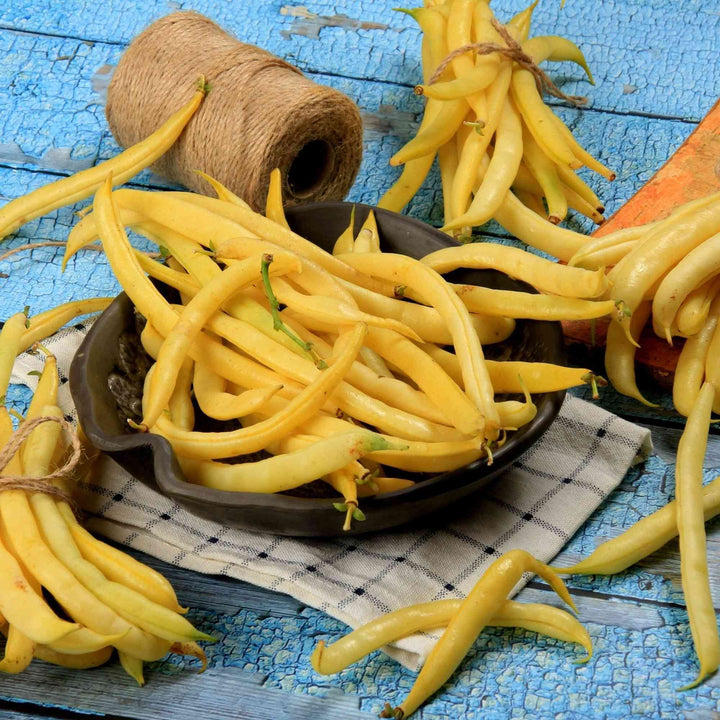
Gold Rush Bush Wax Bean seeds grow into plants with a bush habit, valued for tender wax pods, fresh cooking, freezing, tested pressure canning, and seed saving. The crop produces straight yellow pods about 5.25 in. Tender, mild, and gently sweet when the wax pods are harvested young. This page brings together its documented history, planting needs, harvest stages, kitchen uses, and seed-saving guidance.
About Gold Rush Bush Wax Bean
Gold Rush Bush Wax Bean has a bush habit. Its principal color is yellow, and its pod or seed form is Straight yellow pods about 5.25 in. Flavor: Tender, mild, and gently sweet when the wax pods are harvested young. Best for tender wax pods, fresh cooking, freezing, tested pressure canning, and seed saving. Maturity: 50-59 Days. Plant height: 19–24 in. Support: No-Support.
Botanically, Gold Rush Bush Wax Bean belongs toPhaseolus vulgaris L.Common terms such as bean, pea, butterbean, cowpea, snap, shell, snow, dry, and edible-pod describe crop relationships or harvest uses; they are not interchangeable cultivar names.
History and provenance
Cornell Cooperative Extension identifies Gold Rush as a bush wax bean with clustered yellow pods, a long harvest season, and cultivar-specific disease resistance.
Common bean has distinct Mesoamerican and Andean domestication histories, so a modern cultivar name alone does not reveal which gene pool a seed lot belongs to. This record therefore uses “Uncertain / Multiple Centers” unless the named market class itself supports a narrower classification. Snap, shell, and dry uses are harvest stages or market purposes within the species, not separate botanical species.
Where the surviving record is incomplete, the origin is described as uncertain rather than filled with repeated catalog folklore. A variety name, community association, or regional food use is not used to assign a tribal, ethnic, or national identity to a person connected with the present seed lot.
Pod, seed, flavor, and kitchen use
Gold Rush Bush Wax Bean is selected for tender wax pods, fresh cooking, freezing, tested pressure canning, and seed saving. Tender, mild, and gently sweet when the wax pods are harvested young. The relevant pod or seed form is Straight yellow pods about 5.25 in. Harvest stage determines texture and use: snap and edible-pod crops are picked young; shell beans and peas are harvested with full-size soft seed; dry beans and peas remain until the seed is mature and dry. Cook mature dry beans or peas thoroughly before eating. Use food-safe procedures for any seed intended for sprouting. Culinary quality varies with harvest stage, weather, irrigation, and storage, so the description states a cultivar tendency rather than a guaranteed flavor result.
Growing facts
- Growth habit:Bush
- Plant height:19–24 in
- Maturity:50-59 Days from direct sowing to the primary harvest stage
- Germination:7–14 Days at 65–80 °F
- Seed depth:1 in
- Plant spacing:4 in
- Row spacing:24 in
- Support:No-Support
- Sun and water:Full sun; Moderate water
- Soil:Loamy, well-drained soil at pH 6.0–6.5
- Minimum seed count:25 seeds
Sowing and establishment
Direct sow Gold Rush seed 1 in deep when the soil and season match this crop. Maintain a seed-zone temperature of 65–80 °F; expect emergence in 7–14 Days. Space plants 4 in apart with 24 in between rows. No structural support is normally required; use a short support only if lodging develops. Grow in full sun in loamy, well-drained soil near pH 6.0–6.5. Keep moisture moderate and especially steady during flowering and pod fill, but avoid waterlogged soil. Direct sowing is preferred because large legume seed and young roots can be damaged by rough handling. Apply nitrogen only according to a soil test; excessive nitrogen can produce lush vines at the expense of flowers and pods. Do not cultivate or harvest among wet foliage because bacterial and fungal diseases can be spread mechanically. Cook mature dry beans or peas thoroughly before eating. Use food-safe procedures for any seed intended for sprouting.
Season-long care
Grow Gold Rush Bush Wax Bean in late spring. The crop has a bush habit. Plant height: 19–24 in. Support: No-Support. Seed germinates in 7–14 Days at 65–80 °F; sow 1 in deep, space plants 4 in apart, and leave 24 in between rows. Provide full sun, moderate water, and loamy soil at pH 6.0–6.5. Frost response: Tender. Primary-harvest timing: 50-59 Days. Mulch after seedlings establish to moderate soil moisture and reduce splash. Scout weekly for chewing insects, aphids, distorted growth, spots, wilt, and pod damage. Rotate away from legumes when disease pressure has built, remove seriously diseased plants, and preserve source and lot information when replanting.
Harvest, food use, and storage
Harvest green-shell beans when seed is fully sized but soft, or allow pods to dry completely for pantry and seed use. Plan on 50-59 Days from direct sowing to the primary harvest stage. Use Gold Rush Bush Wax Bean for tender wax pods, fresh cooking, freezing, tested pressure canning, and seed saving. Tender, mild, and gently sweet when the wax pods are harvested young. Cook mature dry beans or peas thoroughly before eating. Use food-safe procedures for any seed intended for sprouting. Cool fresh peas and green pods promptly after harvest. For dry beans or peas, reduce irrigation as seed matures, harvest before shattering or prolonged wet weather, finish curing under cover, shell or thresh gently, and store only fully dry seed. For canning, use a current tested pressure-canning process appropriate to the food; do not substitute an untested method.
Saving seed
Seed Saving
====================
Picking plants
Gold Rush is recorded as Open-Pollinated (OP). Select healthy, true-to-type plants that represent the maintained population rather than saving from one unusually early or large plant.
Isolation/Pollination control
Common beans are primarily self-pollinating, but insects can move pollen. Separate varieties, use blossom barriers, or record the isolation method. Organic Seed Alliance gives 100–150 feet as a home-use reference for snap-bean seed production.
Full maturity
Allow seed pods to pass beyond eating maturity and become fully mature for the species. Harvest before brittle pods shatter, finish curing under cover with airflow, then thresh or shell gently.
Harvesting seeds
Harvest in dry weather when possible. Keep plants or pods from different varieties and selections separate from the moment they leave the row.
Cleaning
Shell or thresh gently, remove chaff, split seed, insect-damaged seed, moldy seed, and obvious off-types. Large legume seed is easily damaged by rough handling.
Drying
Spread cleaned seed in a thin layer with airflow until it is fully dry before sealing. Do not trap field moisture in a jar or plastic bag.
Storing/Labeling
Label crop, cultivar or market class, source, lot, year, grower, location, isolation method, selection notes, harvest stage, and cleaning date. Store cool, dry, dark, and protected from pests.
Viability test
Before an important planting or distribution, test a representative sample and record normal seedlings, abnormal seedlings, hard seed where relevant, and dead seed.
Extra tips
Keep the original packet or photograph it. Compare the next grow-out with this variety description, and document any stable difference before changing the published traits.
Common problems and field diagnosis
Poor emergence usually follows soil that is too cold, saturated, crusted, or compacted, or seed damaged during handling. Recheck the listed germination temperature and seed depth before reseeding. Flower or pod abortion can follow heat, drought, waterlogging, excess nitrogen, or poor pollinator conditions in crops that depend more heavily on insects. Stringy pods often reflect overmaturity or water stress. Yellowing can indicate root stress, nutrient imbalance, disease, or normal late-season dry-down. Avoid diagnosing by one symptom alone. Use local Cooperative Extension guidance and preserve photographs, dates, weather, irrigation, and plant-location notes.
Frequently asked questions
How long does Gold Rush Bush Wax Bean take to germinate?
7–14 Days at 65–80 °F.
When should I harvest it?
50-59 Days.
How tall is the plant?
19–24 in.
What support should I install?
No-Support.
Can I save seed?
Yes, while maintaining selection, isolation, lot identity, and full seed maturity.
Minimum Seed Count:25 seeds