
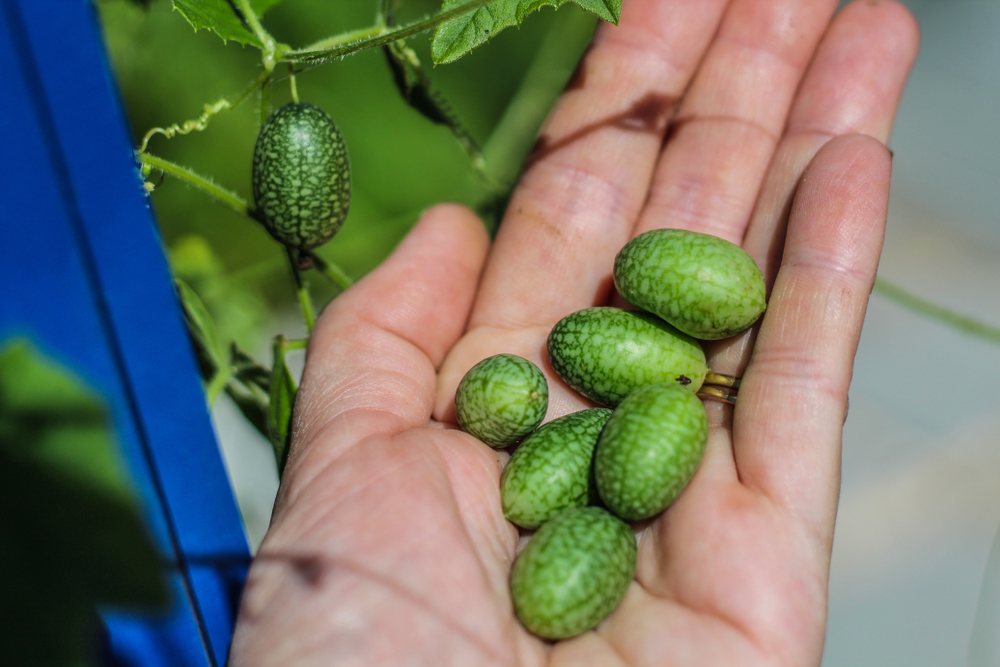
Cucamelons look like tiny watermelons, climb like cucumbers, and taste tart enough to remind you that appearance is not identity. Their common names include cucamelon, Mexican sour gherkin, and mouse melon, but the plant is Melothria scabra, not a miniature watermelon.
The crop wants heat, vertical space, and regular picking. It does not want cold soil, a cramped pot, or fruit left hanging until every seed hardens.
The fruit fits in a spoon. The vine can cover a trellis. Plan the support for the plant, not the harvest basket.
Know what kind of cucamelon you are growing
Cucamelons are tender perennial vines usually grown as annuals in temperate gardens. They produce small yellow flowers and striped green fruits on fine, branching vines.
They are related to cucumbers and melons but belong to a different genus. Growth is slow in cool weather and rapid once nights remain warm.
- Fruit is usually harvested grape-sized.
- Vines climb with tendrils.
- The flavor is crisp, cucumber-like, and tart.
Choose the form or variety for the job
Choose cucamelons when vertical space is available and a long warm season can be provided. They are suited to trellises, fences, and large containers.
Do not choose them as a substitute for slicing cucumbers; the yield, texture, and kitchen use differ.
| Garden goal | Best fit | What to watch |
|---|---|---|
| Small-space trellis | Cucamelon vine | Train upward and harvest often |
| Large container | One or two plants in substantial soil volume | Watch water demand and heat |
| Pickling or snacking | Young firm fruits | Harvest before seediness increases |
| Short cool season | Early indoor start | Transplant only after soil warms |
Start seed at the right time and depth
Start seed indoors about four to six weeks before the safe transplant window, or direct sow after soil is thoroughly warm.
Seeds are small; plant shallowly and provide bottom warmth if the room is cool.
- Sow about 1/4 inch deep.
- Keep the mix evenly moist, not saturated.
- Provide bright light immediately after emergence.
- Harden plants gradually.
Build the site before the plant asks for rescue
Use full sun, loose fertile soil, and a trellis with narrow openings the tendrils can grasp.
Set the support before transplanting. Vines tangle quickly and do not enjoy being untied from neighboring crops.
- Allow airflow.
- Mulch after warming.
- Keep root competition low in containers.
Manage water, fertility, and growth
Water consistently through flowering and fruiting. Severe swings can stall growth, while saturated soil weakens roots.
Feed moderately. Excess nitrogen builds vine at the expense of flowers and fruit.
- Guide vines onto the trellis.
- Inspect flowers for pollinator activity.
- Harvest every few days at peak production.
Harvest at the stage that matches the use
Pick fruits when firm, green, and roughly grape-sized. Overripe fruits become more seedy and sour.
Use fresh, quick-pickled, fermented according to a tested recipe, or added whole to salads and relishes.
Troubleshoot the common failures
Slow early growth, spider mites in heat, root stress in wet soil, and poor fruit set are common.
A vine with flowers but no fruit may lack pollination or be under temperature and moisture stress.
| Symptom | Likely cause | First correction |
|---|---|---|
| Seedlings stall | Cool root zone or weak light | Increase warmth and light |
| Flowers drop without fruit | Pollination or stress problem | Support pollinators and stabilize water |
| Leaves stipple and bronze | Spider mites | Inspect undersides and reduce plant stress |
| Fruit becomes pale and seedy | Harvested too late | Pick smaller and more frequently |
Adjust the plan across the Mid-Atlantic
The long Coastal Plain season suits cucamelons well once spring soil warms. In the Piedmont, an indoor start gives them a useful lead. Mountain gardens may need the earliest safe start and a warm, sheltered site.
Frost ends top growth, though tuberous roots may sometimes be lifted and stored by experienced growers.
Do not rush them into cold ground; a warm late transplant often outruns a chilled early one.
Put this guide to work in a real garden
Put How to Grow Cucamelons: Heat, Trellising, Harvest, and the Mexican Sour Gherkin Name into a one-season plan before buying more inputs. Choose the variety or material, mark the bed or container, write the sowing or planting date, and decide what success will look like: first harvest, stem length, fruit set, bloom, survival, or control of spread.
Inspect on a schedule. Early problems are usually easier to correct because the crop has more season left and the cause has not been buried under secondary damage. Water, fertility, airflow, support, and harvest timing should be adjusted from the plant’s response rather than from a rigid weekly ritual.
At the end of the crop, keep the record honest. Note what performed, what merely survived, what required too much labor, and what deserves a larger planting next year. Experience becomes expertise only when it is remembered accurately.
- Choose the variety and define the intended use.
- Prepare soil, container, support, or irrigation before planting.
- Set a weekly inspection date.
- Harvest or prune at the stage described in the guide.
- Write a short end-of-season verdict.
Use a 30-day checkpoint instead of guesswork
Before planting
Choose the variety, site, support, soil preparation, and irrigation method while the bed is still easy to change.
First two weeks
Protect establishment. Watch moisture, light, wind, transplant shock, and early pest pressure.
At rapid growth
Adjust spacing, support, pruning, and fertility before the plant becomes difficult to handle.
At first harvest or bloom
Record quality, timing, labor, and the plant’s response. Use that evidence to guide the rest of the season.
A guide provides a sound starting system, not a guarantee. Cultivar, weather, soil history, and management interact, and the correct response may change as the plant moves from establishment to harvest.
Keep a one-season record
The record does not need to be elaborate. A notebook page, spreadsheet row, or labeled photograph is enough when it captures the variables that matter.
- Variety and source
- Planting date and location
- Water, fertility, and major weather events
- First harvest or bloom and total season length
- Problems, corrections, and next-year decision
Write enough that another grower—or you, one year later—could understand what was planted, what happened, and why the next decision changed.
Questions gardeners ask
Are cucamelons actually melons?
No. They are Melothria scabra, a cucurbit relative with small striped fruits, but not miniature watermelons.
Do cucamelons need a trellis?
They can sprawl, but a trellis improves harvest, airflow, and use of space.
How long do cucamelons take to grow?
They are slower than many cucumbers, especially in cool weather. Start early where the warm season is short.
Why are my cucamelons sour?
A pleasant tartness is normal. Overripe fruits can become more sour and seedy.
Can cucamelons grow in pots?
Yes, in a large container with a trellis, strong light, and consistent moisture.
Cucamelons are a small harvest from an ambitious vine. Give them heat, height, and a gardener who picks before the fruit decides to become seed.


