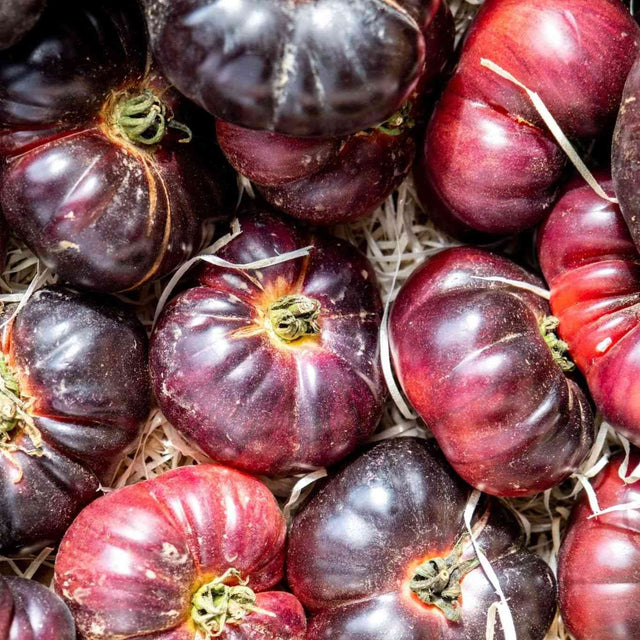
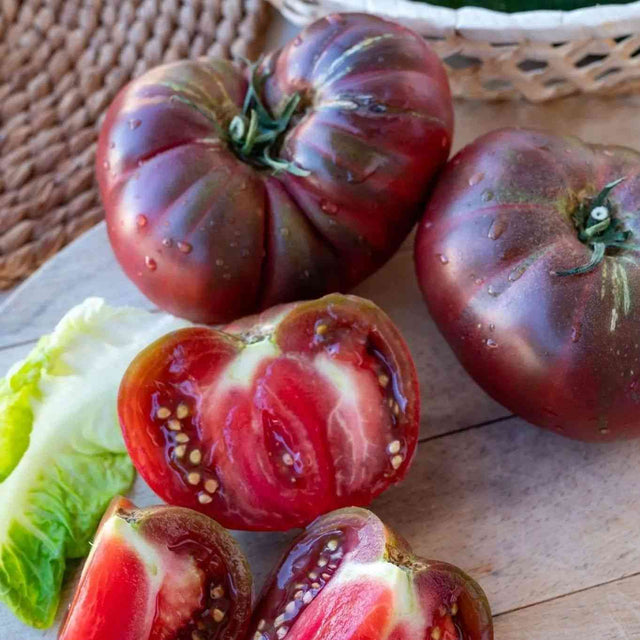
Cherokee Purple tomato is not famous because the fruit is tidy. It is famous because one ripe slice can make a gardener stop talking. The fruit is dusky rose-purple, often green across the shoulders, soft-skinned, richly scented, and full of the kind of smoky-sweet acidity that modern shipping tomatoes were never bred to protect.
But flavor is only half the work. Cherokee Purple Tomato Seeds grow into long-season, indeterminate plants that need warmth, strong support, steady moisture, and enough time to finish. This guide treats the variety as a living crop rather than a legend. We will separate the documented history from the repeated story, then move through seed starting, transplanting, support, ripeness, disease pressure, kitchen use, and seed saving.

What Cherokee Purple tomato actually is
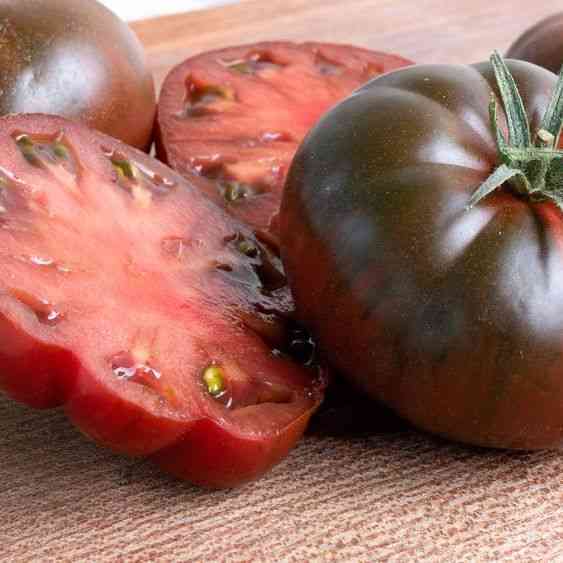
Cherokee Purple is an open-pollinated, indeterminate slicing tomato. The plants continue growing and flowering until frost, disease, or severe stress stops them. Fruits commonly fall near 10 to 12 ounces, although careful culture can produce larger specimens. They are usually somewhat flattened, with pink to rose-purple skin over deep crimson flesh and darker shoulders where sunlight and chlorophyll interact.
The word “purple” in tomato descriptions does not mean the fruit contains the same blue-purple pigments seen in an eggplant or an anthocyanin tomato. Cherokee Purple belongs to the older group of dark or so-called black tomatoes whose color comes from crimson flesh showing through relatively clear skin, often combined with retained chlorophyll in the shoulders. That layered color is one reason photographs vary so much. Light, ripeness, temperature, and camera processing can make the same variety look brown, burgundy, violet, or nearly black.
Growth habit
Indeterminate, vigorous, and best grown with a heavy cage, trellis, or strong staking system installed at transplanting.
Fruit character
Large, slightly flattened slicers with dusky rose-purple skin, deep crimson flesh, soft shoulders, and balanced smoky-sweet flavor.
Season
Mid-to-late season. Expect roughly 80 to 89 days from a healthy transplant under suitable growing conditions.
Best use
Fresh slicing, sandwiches, tomato toast, salads, tasting plates, sauces where fresh flavor matters, and home seed saving.
The documented modern history of Cherokee Purple
The documented modern story begins with a packet of unnamed purple tomato seed mailed to North Carolina tomato collector Craig LeHoullier by J. D. Green of Sevierville, Tennessee, in 1990. Green shared a family account that neighbors had received the tomato through Cherokee people many years earlier. LeHoullier grew the seed, recognized that the fruit was unusual, named it Cherokee Purple, and began sharing it through seed-saving networks. Jeff McCormack later placed it into a commercial seed catalog in 1993, and the variety moved from a private packet into gardens across the country.
LeHoullier's own records are unusually useful because he maintained numbered seed samples and later grew seed only a few generations removed from Green's original packet. His published notes document the chain from the unnamed accession to later grow-outs and describe the variety as stable in color, size, flavor, and general performance. That is a stronger record than the usual catalog paragraph copied from one seller to the next.
Careful history does not diminish the tomato. It protects everyone involved. Cherokee people are not a marketing adjective, and a seedkeeper's record should not grow more certain every time it is copied. The responsible language is simple: the Cherokee connection is a reported family history attached to the seed Green shared, while the modern naming and distribution are well documented.
A dark tomato in late summer holds the whole season in it: heat in the shoulders, rain in the skin, and patience in the seed.
Begin with a trustworthy seed source
Cherokee Purple is popular enough that mislabeled, crossed, or carelessly maintained seed circulates widely. A dark tomato is not automatically Cherokee Purple. Black Krim, Black from Tula, Paul Robeson, Cherokee Chocolate, and many other varieties can look similar in a market basket or an online photograph.
Choose seed from a source that preserves the exact variety name, uses a lot or inventory system, performs germination checks, and describes the fruit and plant consistently. Once the crop is growing, rogue obvious off-types before saving seed. Watch for fruit that ripens bright red instead of dusky rose-purple, plants with a clearly determinate habit, unusual leaf types, or fruit shape far outside the expected range. Environmental stress can change size and yield, so one small fruit is not proof of a cross. Repeated, structural differences are more meaningful.
How to start Cherokee Purple tomato seeds
Start seed indoors about six to eight weeks before the last expected spring frost. The goal is not to produce the largest possible transplant. The goal is a compact, well-rooted plant that can move into the garden without a long recovery.
- Use a clean, fine seed-starting mix. Garden soil is usually too dense for trays and may carry damping-off organisms.
- Sow about 1/4 inch deep. Cover lightly, firm the surface, and water without washing the seed into a corner.
- Keep the mix warm and evenly moist. A soil temperature around 75 to 85°F usually supports fast, even emergence. Do not keep the tray waterlogged.
- Provide strong light immediately after emergence. Weak light creates long, thin stems that never become stronger by being buried in shade.
- Pot up before roots become severely bound. Move seedlings into larger cells or small pots when they have several true leaves and the original container is filling with roots.
Germination commonly begins within a week under warm conditions, but do not discard a tray on day seven. Temperature variation, seed age, sowing depth, and moisture can stretch the emergence window. Keep labels with the tray. In a working seed room, an unlabeled tray is not a mystery. It is a mistake waiting to become inventory.


Potting up, hardening off, and transplanting
Tomatoes can form roots along buried stem tissue, which allows a leggy but healthy plant to be set deeper at transplanting. That ability is useful, but it should not become an excuse to grow weak seedlings. Give the young plants air movement, strong light, and room before the stems stretch.
Begin hardening off about a week before planting. Move plants into filtered outdoor light and mild conditions, then increase exposure over several days. Protect them from hard wind, cold nights, and the first fierce noon sun. A greenhouse-grown leaf can scorch quickly outdoors even when the air temperature feels pleasant.
Transplant after frost danger has passed, nights are reliably mild, and the soil has warmed. In much of eastern North Carolina and the lower Mid-Atlantic, the calendar may suggest spring while the ground remains cold after rain. Cherokee Purple does not gain anything by sitting in chilled soil. A plant held a few more days in good light is often better than a plant rushed into a cold bed.
Give the vine real support, not a decorative stake
Cherokee Purple produces heavy fruit on a long vine. A short retail tomato cage often collapses just as the crop becomes valuable. Install a heavy cage, Florida weave, cattle-panel trellis, or substantial stake system at planting time. Driving support beside a mature root system causes more damage and more cursing than planning ahead.
Space plants about 30 inches apart as a practical minimum, with more room in humid gardens or where disease pressure is persistent. Airflow does not prevent every leaf disease, but crowded foliage remains wet longer and makes inspection difficult. Keep the lowest leaves from resting on the soil, and remove leaves that are yellowing, badly spotted, or touching wet mulch. Do not strip the plant bare. Fruit exposed suddenly to intense sun can scald.
A support system is adequate when it can:
- carry several pounds of fruit without bending into the path;
- keep foliage off the ground after a thunderstorm;
- allow you to reach the center of the plant for harvest and inspection;
- survive the full season without being rebuilt around mature roots.

Soil, fertility, and the discipline of even moisture
Grow Cherokee Purple in full sun and fertile, well-drained soil. A slightly acidic root zone near pH 6.0 to 6.8 suits tomatoes in most gardens, but the correct amendment depends on a soil test. Do not add lime, phosphorus, or calcium merely because a generic tomato article lists it. More is not automatically better, and excessive amendment can create new nutrient problems.
Work mature compost into poor soil before planting, then feed according to the condition of the bed and the plant. Too much nitrogen produces a handsome wall of foliage with delayed flowering and soft growth. Once fruit set begins, the crop needs steady water and access to a balanced nutrient supply more than repeated heavy feeding.
Deep, regular watering is more useful than frequent shallow sprinkling. Water the root zone, then allow air to return to the soil. Mulch after the ground has warmed to reduce evaporation and soil splash. Keep mulch a little away from the stem. Sudden swings from dry soil to saturation encourage cracking and can interfere with calcium movement into rapidly expanding fruit.

Flowers, heat, and fruit set
Tomato flowers are primarily self-pollinating, but they still need viable pollen and enough vibration for pollen to move within the flower. Wind, bumblebees, and routine plant movement usually do the work. During long periods of high daytime heat or warm nights, pollen can become less viable and blossoms may drop without forming fruit. That is not always a fertilizer problem.
Keep plants watered, avoid pushing soft growth with excess nitrogen, and wait for better conditions. Once temperatures moderate, new clusters often set. Shade cloth can reduce extreme afternoon stress in exposed southern gardens, but heavy shade lowers production. The aim is to soften the worst heat, not turn a tomato bed into a woodland edge.
How to tell when Cherokee Purple is ripe
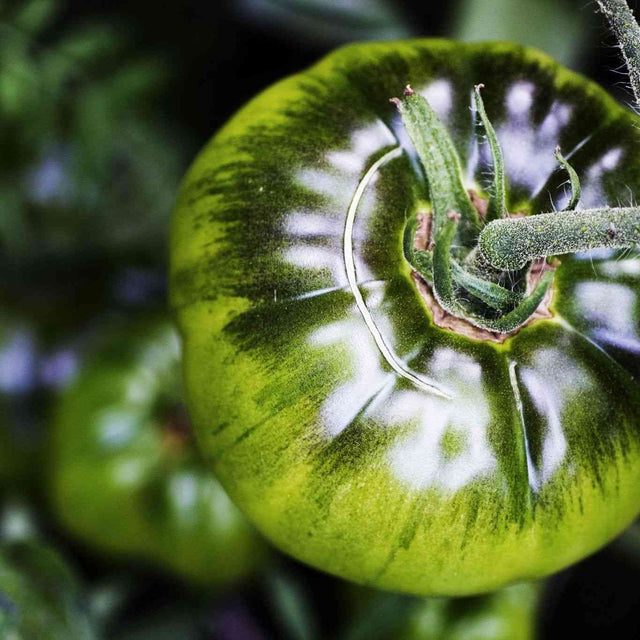
The most common mistake is waiting for the shoulders to become uniformly red. Cherokee Purple may retain olive-green or darker shoulders even when the fruit is ready. Judge ripeness by several signals together:
- the lower and middle fruit has shifted from green to dusky rose-purple;
- the surface has lost its hard, immature shine;
- the fruit yields slightly to gentle pressure without feeling watery;
- the aroma becomes noticeable near the stem;
- the fruit releases from the vine with a careful twist or cuts cleanly at the stem.
In heavy rain or when cracking is likely, pick at the first clear blush and finish ripening indoors out of direct sun. Flavor develops best when the fruit is allowed substantial time on the plant, but a split tomato has no respect for a purist's schedule.
Too early
Hard fruit, mostly green background, little aroma, and no give under gentle pressure.
Ready
Dusky color across most of the fruit, rich aroma, slight softness, and firm flesh beneath the skin.
Overripe
Very soft shoulders, leaking cracks, translucent skin, sour odor, or flesh beginning to collapse.
Storm harvest
Pick at first blush before prolonged rain, then ripen at room temperature with airflow.
Harvest, kitchen use, and storage
Handle ripe Cherokee Purple tomatoes as though the skin has already decided to split. Use shallow trays rather than deep buckets, keep fruit out of direct sun after harvest, and avoid stacking heavy tomatoes on one another. Do not refrigerate a fully ripe tomato unless spoilage is the only alternative. Cool temperatures dull aroma and change texture.
This variety earns its reputation in simple food. Slice it thick for sandwiches, salt it lightly for tomato toast, or serve several dark tomatoes side by side to compare acidity and finish. The flesh is tender and juicy rather than dry, so sauce cooks down more slowly than a paste tomato. That does not make poor sauce. It makes a different sauce, one built on flavor rather than efficiency.
Cracking, disease, and the problems most often blamed on the seed
Cherokee Purple is not a modern disease-resistance package. It can perform beautifully, but the crop asks for observation. The most common problems are connected to weather, moisture, airflow, and the long season rather than a failure to germinate.
| Symptom | Likely causes | Response |
|---|---|---|
| Radial or concentric cracking | Rapid water uptake after dry soil, heavy rain, advanced ripeness | Maintain steadier moisture, mulch, harvest at first blush before storms |
| Dark sunken blossom end | Calcium delivery disrupted by uneven moisture, root stress, rapid growth | Correct watering and root-zone stress; amend calcium only when a soil test supports it |
| Flowers fall without fruit | Heat, warm nights, humidity, drought, excess nitrogen | Keep plants steady and wait for favorable flower clusters |
| Lower leaves develop target-like spots | Early blight or another leaf-spot disease | Remove badly affected leaves, reduce splash, rotate crops, improve airflow |
| Many small spots with pale centers | Septoria leaf spot is one possibility | Inspect closely, remove infected debris, avoid overhead watering, rotate away from tomatoes |
| Green shoulders on otherwise ripe fruit | Normal varietal coloring, intense sun, uneven ripening | Judge the whole fruit; do not wait for every shoulder to turn red |
Sanitation matters. Remove diseased leaves from the garden, clean support systems before reuse, rotate tomatoes and their close relatives, and avoid handling wet foliage. If disease arrives every year, change more than the spray bottle. Change the planting location, airflow, mulch, watering method, and timing.

How to save Cherokee Purple tomato seed
Cherokee Purple is open-pollinated and primarily self-pollinating, so home gardeners can save seed successfully. Cross-pollination is still possible, particularly in flowers with exposed stigmas and where pollinating bees are active. If varietal purity matters, separate varieties according to a seed-production plan or bag unopened flower clusters before they open and label the protected fruit.
- Select the plant before selecting the fruit. Choose healthy, true-to-type plants with the growth, fruit, and season performance you want to continue.
- Save from more than one plant when possible. A variety is stronger when its future is not narrowed to one accidental survivor.
- Allow fruit to become fully ripe. Seed reaches maturity late in fruit development.
- Scoop seed and gel into a labeled container. Add a small amount of water only if needed.
- Ferment briefly. Stir once or twice daily. When the gel loosens and viable seed settles, usually after a few days depending on temperature, rinse thoroughly.
- Dry in a thin layer. Use a screen, plate, coffee filter, or other nonabsorbent surface with airflow. Break clumps apart as they dry.
- Store only when completely dry. Label variety, year, source plant count, and any isolation method.
Do not save seed from badly diseased plants. Fermentation helps clean the gelatinous coating but does not make infected seed magically safe. Commercial seed health requires stricter sanitation and testing than a casual home seed jar.
Cherokee Purple compared with other dark tomatoes
| Variety | Typical character | Why a gardener might choose it |
|---|---|---|
| Cherokee Purple | Rose-purple slicer, deep crimson flesh, green shoulders, balanced smoky-sweet flavor | Legendary fresh flavor and a well-documented modern seed-sharing history |
| Black Krim | Dark maroon fruit, often with green shoulders and a salty, rich finish | A classic dark beefsteak with a different shape and flavor profile |
| Black from Tula | Large dark slicer, rich and complex, often more irregular | For gardeners comparing substantial dark beefsteaks |
| Paul Robeson | Dusky red-brown fruit with deep savory flavor | For a dark slicer with its own distinct history and flavor balance |
Mid-Atlantic and Upper South field note
In humid North Carolina and Virginia gardens, Cherokee Purple often succeeds or fails on airflow and moisture discipline. Plant after cold soil has passed, give the vine space, mulch after the ground warms, and expect disease pressure to rise as summer humidity settles in. In mountain gardens, start early enough to finish the crop. Near the coast, protect flowers and roots through extreme heat and saturated storm periods.
Frequently asked questions about Cherokee Purple
Is Cherokee Purple really a Cherokee tomato?
The modern chain is documented from J. D. Green's 1990 seed packet to Craig LeHoullier, who named and distributed the variety. Green shared a family account connecting the tomato to Cherokee people through neighbors. That earlier connection is reported history, not independently verified tribal provenance.
Why are the shoulders still green when the tomato feels ripe?
Retained green shoulders are normal for Cherokee Purple. Judge the entire fruit by background color, aroma, and slight softness rather than waiting for the shoulders to become uniformly red.
How tall does Cherokee Purple grow?
It is indeterminate and commonly reaches 4 to 6 feet or more, depending on season length, soil, pruning, and support. Plan for a heavy cage or trellis rather than a short decorative cage.
Why did my Cherokee Purple tomatoes crack?
Large, soft-skinned fruit can crack after dry soil is followed by heavy irrigation or rain. Maintain steadier moisture, mulch after the soil warms, and harvest fruit at first blush before long wet periods.
Can Cherokee Purple grow in a container?
Yes, but use a large container with excellent drainage, reliable watering, and a support system anchored for a mature indeterminate vine. Small pots create severe moisture swings.
Should Cherokee Purple be pruned to one stem?
Not necessarily. One-stem pruning can make a plant easier to manage on a trellis, but it reduces leaf cover and total growing points. In hot climates, over-pruning can expose fruit to sunscald. Match pruning to the support system and climate.
Will saved Cherokee Purple seed grow true?
Seed from a healthy, true-to-type plant usually grows very similar to the parent because the variety is open-pollinated and tomatoes are primarily self-pollinating. Use isolation or blossom bagging when higher purity matters.