Variety field guide
What to expect from Violet Queen Cauliflower
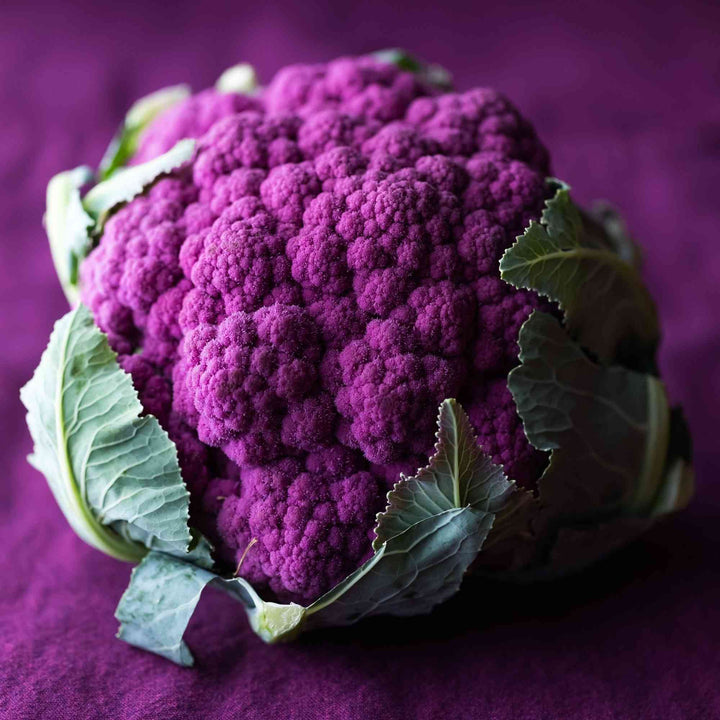
Violet Queen brings rich purple color to a cauliflower head framed by dark green leaves.
Open the complete descriptionHide the complete descriptionVariety traits, flavor, garden use, and the complete description
Violet Queen brings rich purple color to a cauliflower head framed by dark green leaves. Its mild, sweet florets are attractive on a raw vegetable plate, and they soften into a mellow side dish when steamed or roasted. Cooking usually turns the purple color green. Unlike white cauliflower, the heads need no leaf covering to keep their color. Give plants a cool growing season and steady water so the curds develop well before hot weather arrives.
Minimum seeds per packet: 300 seeds.
Rich purple florets for colorful fresh vegetable platters.
Variety and background
The current supplier lists Violet Queen as open-pollinated, while breeder records describe the original Violet Queen as F1. Lot-specific status remains unconfirmed. Purple curds can turn green when cooked; tying leaves for white-curd blanching is unnecessary.
Growing facts
| Scientific name | Brassica oleracea L. Botrytis Group |
|---|---|
| Life cycle | Biennial |
| Maturity / harvest basis | 80-89 Days |
| Seed depth | 1/4-1/2 in |
| Germination | 4-10 days |
| Germination temperature | 65-75 F |
| Plant height / spread | 25–30 in |
| Habit | Upright/Erect |
| Plant spacing | 18 in |
| Row spacing | 30 in |
| Sunlight | Full sun |
| Pollination type | Unconfirmed for current lot; supplier and breeder records conflict |
Starting from seed
Start indoors 4-6 weeks before planting for a cool-season harvest. Sow 1/4-1/2 in. deep; at 65-75 F allow 4-10 days. Harden off; set 18-24 in. apart, rows 24-30 in. apart. Give fertile soil, even water and room for the leaves.
Planting and care
Start indoors 4-6 weeks before planting for a cool-season harvest. Sow 1/4-1/2 in. deep; at 65-75 F allow 4-10 days. Harden off; set 18-24 in. apart, rows 24-30 in. apart. Give fertile soil, even water and room for the leaves. The current supplier lists Violet Queen as open-pollinated, while breeder records describe the original Violet Queen as F1. Lot-specific status remains unconfirmed. Purple curds can turn green when cooked; tying leaves for white-curd blanching is unnecessary.
Harvest and use
Cut full heads while curds remain firm, with a few wrapper leaves attached. Refrigerate promptly. For a seed crop, leave heads to flower and isolate other B. oleracea. Saved seedlings may vary; uniform offspring are not assured.
Saving seed
Saved seed may vary from the purchased selection. The current supplier lists Violet Queen as open-pollinated, while breeder records describe the original Violet Queen as F1. Lot-specific status remains unconfirmed. Purple curds can turn green when cooked; tying leaves for white-curd blanching is unnecessary. For reliable repetition, use seed of the identified supplier selection. When saving seed for observation, keep compatible flowering varieties separated, let seed reach full maturity, dry it thoroughly and label its origin and year.
Common problems
Common concerns: Flea beetles, imported cabbageworm, cabbage loopers, aphids, slugs, root maggots, and clubroot risk where the pathogen is present. Management: Use rotation, insect netting before pests arrive, regular leaf inspection, sanitation, and well-drained soil. Do not plant the same brassica family repeatedly in one bed. Diagnosis note: Similar symptoms can have different causes. Compare plants of the same age, record weather and irrigation, and use local Extension or diagnostic support before applying a control.
Frequently asked questions
What distinguishes this selection?
The current supplier lists Violet Queen as open-pollinated, while breeder records describe the original Violet Queen as F1. Lot-specific status remains unconfirmed. Purple curds can turn green when cooked; tying leaves for white-curd blanching is unnecessary.
How should I start it?
Start indoors 4-6 weeks before planting for a cool-season harvest. Sow 1/4-1/2 in. deep; at 65-75 F allow 4-10 days. Harden off; set 18-24 in. apart, rows 24-30 in. apart. Give fertile soil, even water and room for the leaves.
When and how should I harvest?
Cut full heads while curds remain firm, with a few wrapper leaves attached. Refrigerate promptly. For a seed crop, leave heads to flower and isolate other B. oleracea. Saved seedlings may vary; uniform offspring are not assured.
Can I save seed?
Saved seed may vary from the purchased selection. The current supplier lists Violet Queen as open-pollinated, while breeder records describe the original Violet Queen as F1. Lot-specific status remains unconfirmed. Purple curds can turn green when cooked; tying leaves for white-curd blanching is unnecessary. For reliable repetition, use seed of the identified supplier selection. When saving seed for observation, keep compatible flowering varieties separated, let seed reach full maturity, dry it thoroughly and label its origin and year.