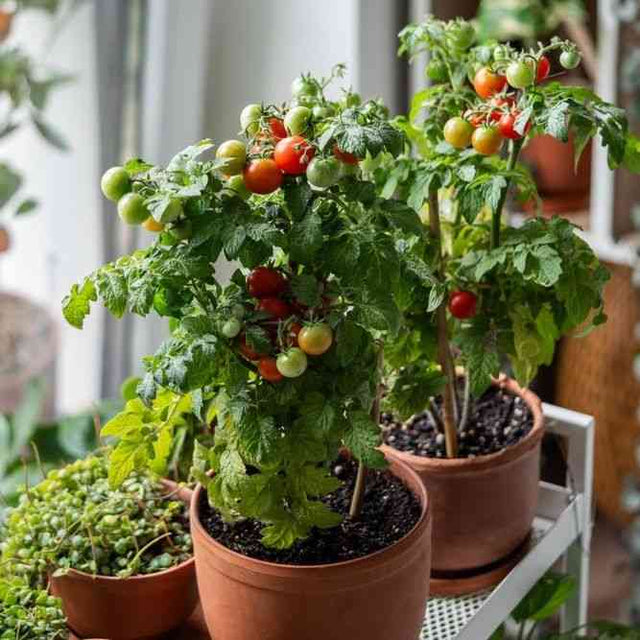
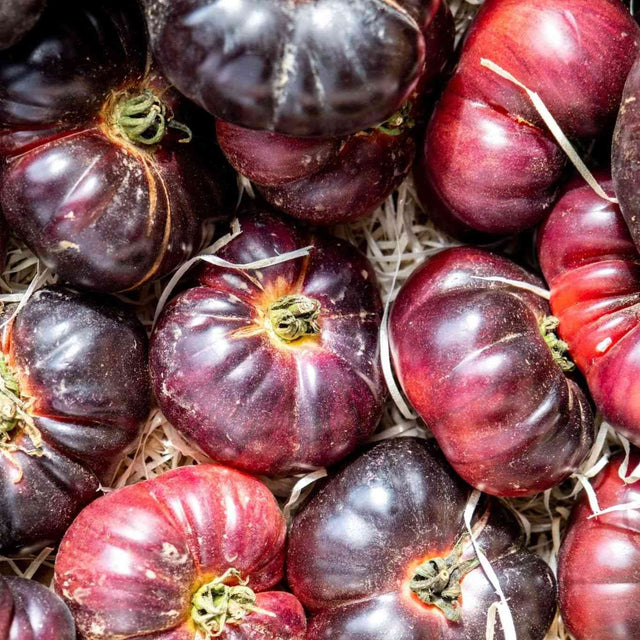
The best tomato support depends on the plant habit, crop load, available space, and the amount of maintenance the gardener can provide.
A seven-foot indeterminate slicer and a compact determinate paste tomato should not be trained the same way. A tomato grown in a humid backyard with a history of leaf disease may need more airflow than one in a dry high tunnel. A gardener who enjoys weekly pruning can use a different system from a gardener who travels for work.
Support is not decoration. It is the skeleton of the season. Pruning is not a moral test of whether a gardener is disciplined. It is one management tool, and too much of it can expose fruit, remove productive leaf area, and turn a healthy plant into a stressed one.
Support the plant before it needs rescue. Prune for a reason - airflow, access, or training - not because every sucker is an enemy.
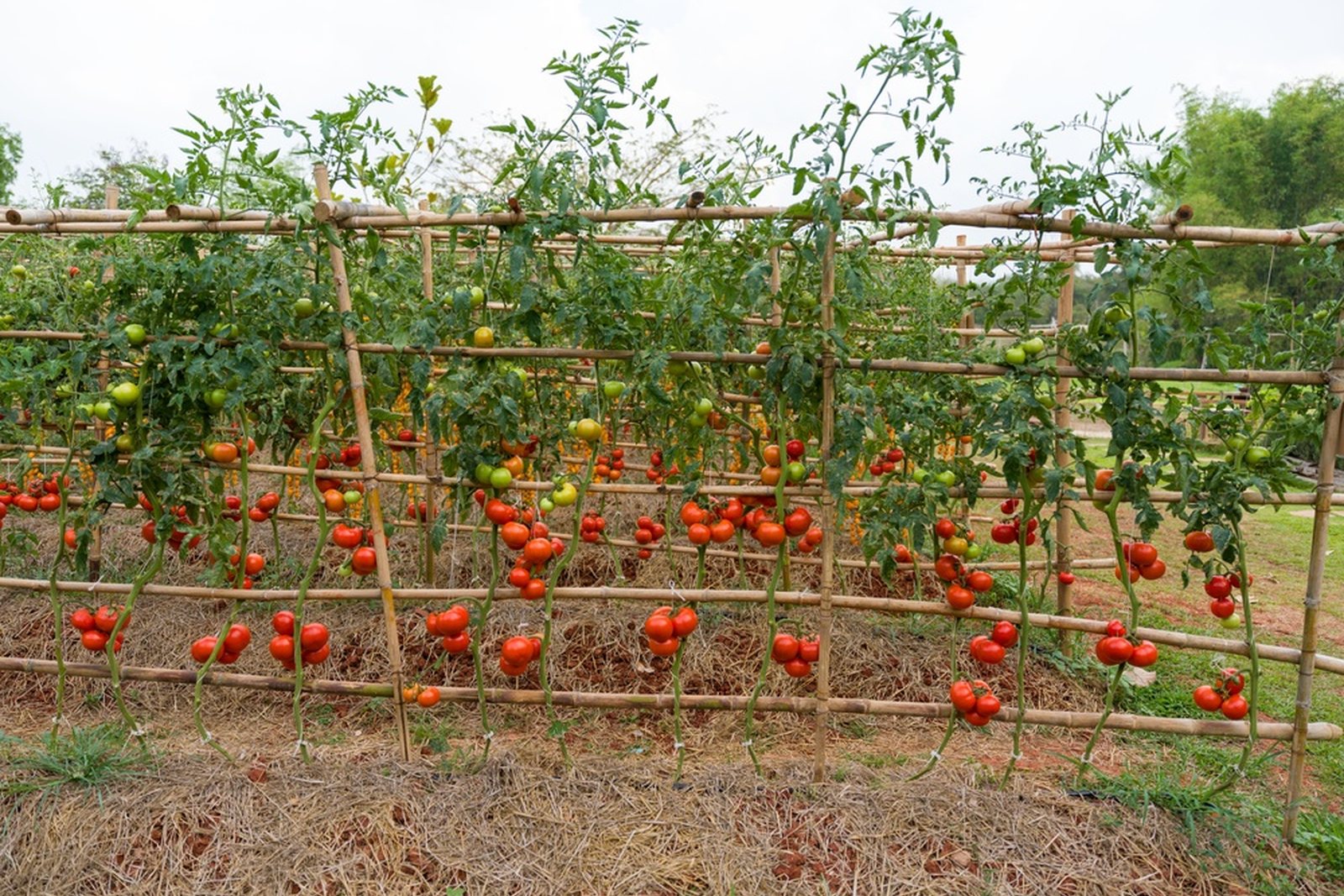
Support and pruning dimensions that hold up in August
Build for the mature wet plant loaded with fruit and pushed by wind. A support that looks large around a transplant may be inadequate six weeks later.
| Field measure | Practical starting point | How to use it |
|---|---|---|
| Heavy cage | About 5 to 6 feet tall and 18 to 24 inches wide | Use strong wire and anchor it. Small decorative cages are usually too weak for vigorous indeterminate vines. |
| Single stake | 6 to 8 feet long, driven 12 to 18 inches into firm soil | Best for one or two trained leaders. Tie the stem repeatedly as it grows. |
| Trellis | At least 6 feet tall for standard indeterminates | Provide secure top and bottom anchors plus access for harvest and pruning. |
| Florida weave | Stakes every 2 to 3 plants with twine added every 8 to 12 inches of growth | Tension both sides of the row and reinforce end posts. |
| Tie spacing | Roughly every 8 to 12 inches of new stem | Use soft, wide ties and leave room for stem expansion. |
| Lower-leaf clearance | Gradually clear about 8 to 12 inches above the soil after plants establish | Remove soil-contact leaves and diseased tissue. Do not strip a large share of healthy canopy at once. |
| Determinate pruning | Usually limited to damaged, soil-contact, or diseased leaves | Heavy sucker removal can remove a large part of the planned crop. |
| Indeterminate training | One, two, or several leaders depending on spacing and support | Choose the system in advance. Random pruning creates a crowded plant with weak structure. |
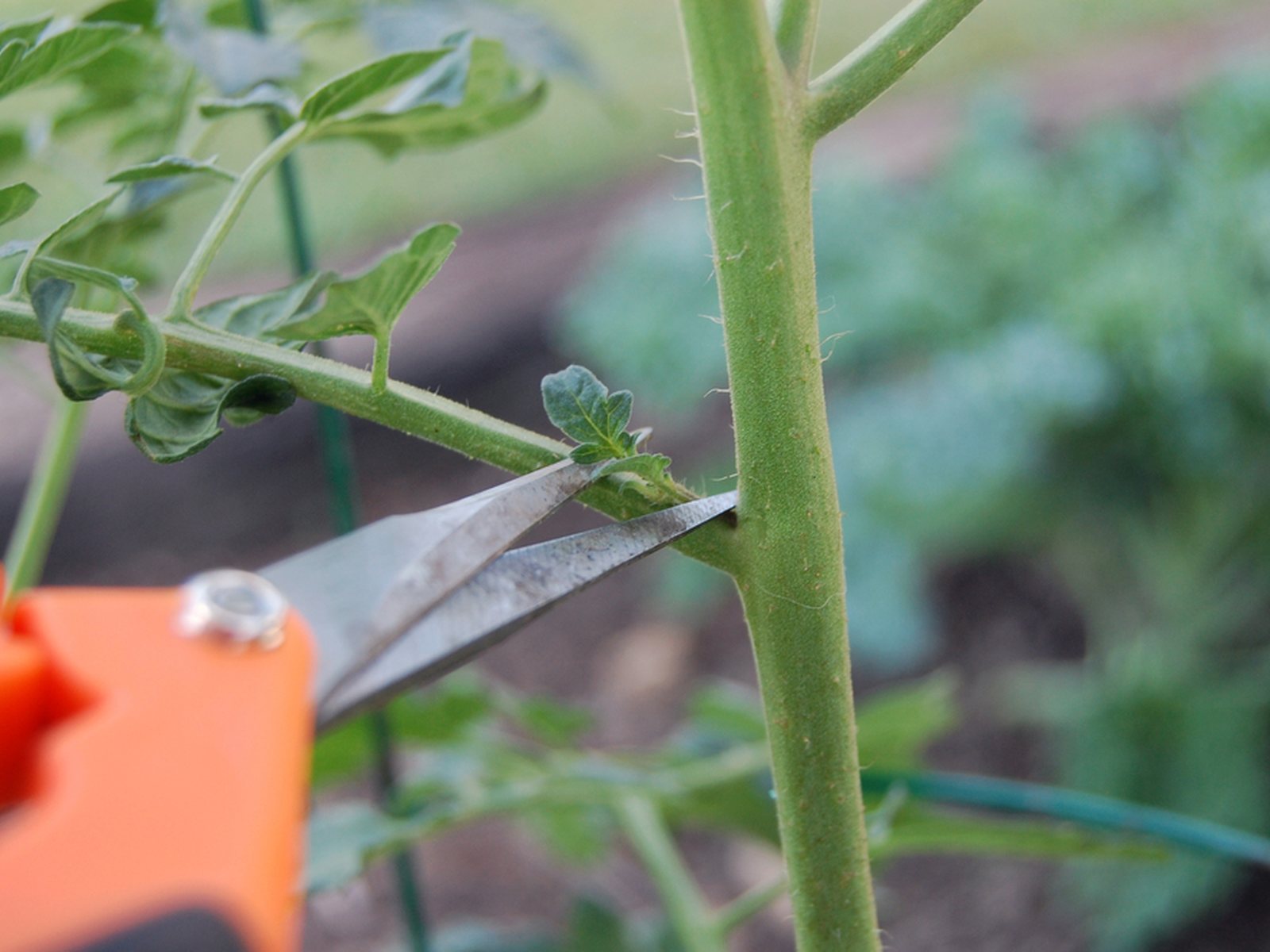
Suckers form in the angle between a leaf and the main stem. They are new stems, not parasites. Removing them changes the number of leaders, the amount of leaf area, fruit size distribution, and labor. It is a training decision, not a universal tomato rule.
Hot climates require restraint. Leaves shade fruit and reduce sunscald. Remove foliage that touches soil, blocks access, or is diseased, but keep a functional canopy over developing fruit. Avoid major pruning immediately before a heat wave.
Support helps disease management by keeping leaves and fruit off the soil and improving access for scouting. It does not make a dense, wet canopy disease-proof. Spacing, mulch, root-zone irrigation, sanitation, rotation, and correct diagnosis still matter.
Load-test the support
- Push the empty support from several directions before planting.
- Check that stakes and end posts cannot rotate in wet soil.
- Confirm that ties will not cut into the stem.
- Leave an aisle wide enough for harvest without breaking branches.
- Plan how the structure will be cleaned, stored, or rotated after the season.
Important: Do not remove every sucker or every lower leaf by default. The correct amount depends on habit, spacing, climate, support, and disease pressure.
Start with determinate, indeterminate, dwarf, or micro habit
Determinate tomatoes grow to a more limited size and set much of their crop in a concentrated window. They benefit from cages or stakes but usually should not be heavily pruned because removing shoots removes future flowers.
Indeterminate tomatoes continue growing and flowering through the season. They can be trained to one, two, or several leaders depending on the support system and climate.
Dwarf and micro tomatoes have compact genetics, but fruit load can still bend stems. They may need small cages or stakes even when pruning is minimal.
Read the habit first. A pruning tutorial that does not ask the habit is incomplete.
Cages, stakes, trellises, and Florida weave compared
| System | Best for | Advantages | Tradeoffs |
|---|---|---|---|
| Heavy cage | Home gardens, large indeterminate or determinate plants | Low weekly tying, preserves canopy | Requires strong cage and storage space |
| Single stake | Pruned indeterminate tomatoes | Compact footprint, good airflow | Frequent tying and pruning; lower leaf area |
| Vertical string | Greenhouses, high tunnels, structured rows | Efficient training and harvest | Requires overhead support and regular clips |
| Florida weave | Rows of field tomatoes | Shares posts, scalable | Needs tension and repeated weaving |
| Trellis panel | Small garden rows, mixed leaders | Strong, reusable | Access and tying must be planned |
| Short cage or stake | Determinate, dwarf, patio types | Simple, prevents lodging | Must match final plant and fruit load |
Cheap cages often fail exactly when the crop is heaviest. Build for wet foliage, fruit weight, wind, and the force of a mature vine leaning after a storm.
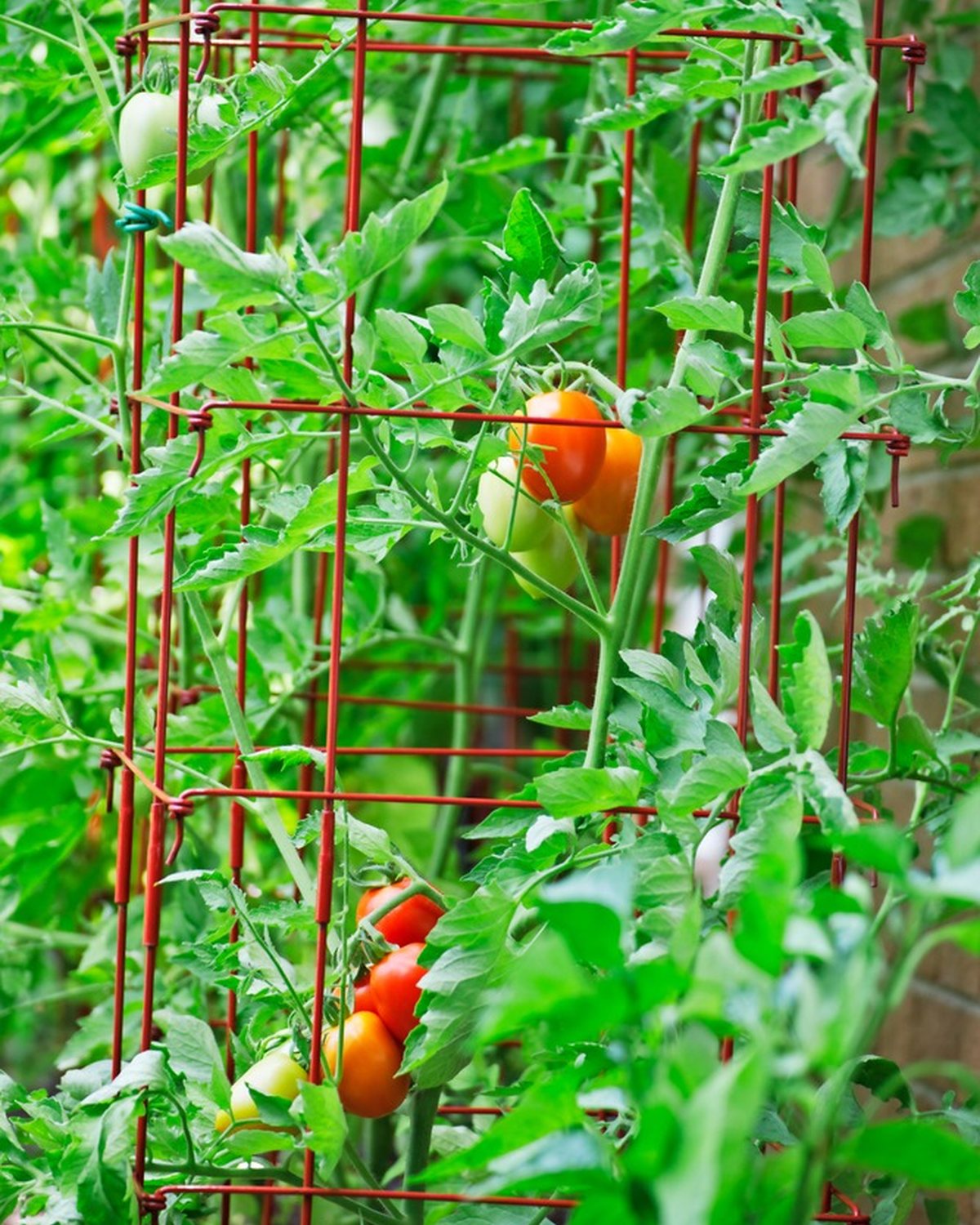
Install support at planting or transplanting
Set cages, stakes, or posts before roots spread and before stems begin leaning. Late installation damages roots and forces the plant through tight openings.
Place the support on the side that allows easy tying and harvest. In rows, plan access from both sides. Sanitize reused stakes and clips when disease was present the previous season.
A support system should make the plant easier to inspect, not create a wall that hides problems.
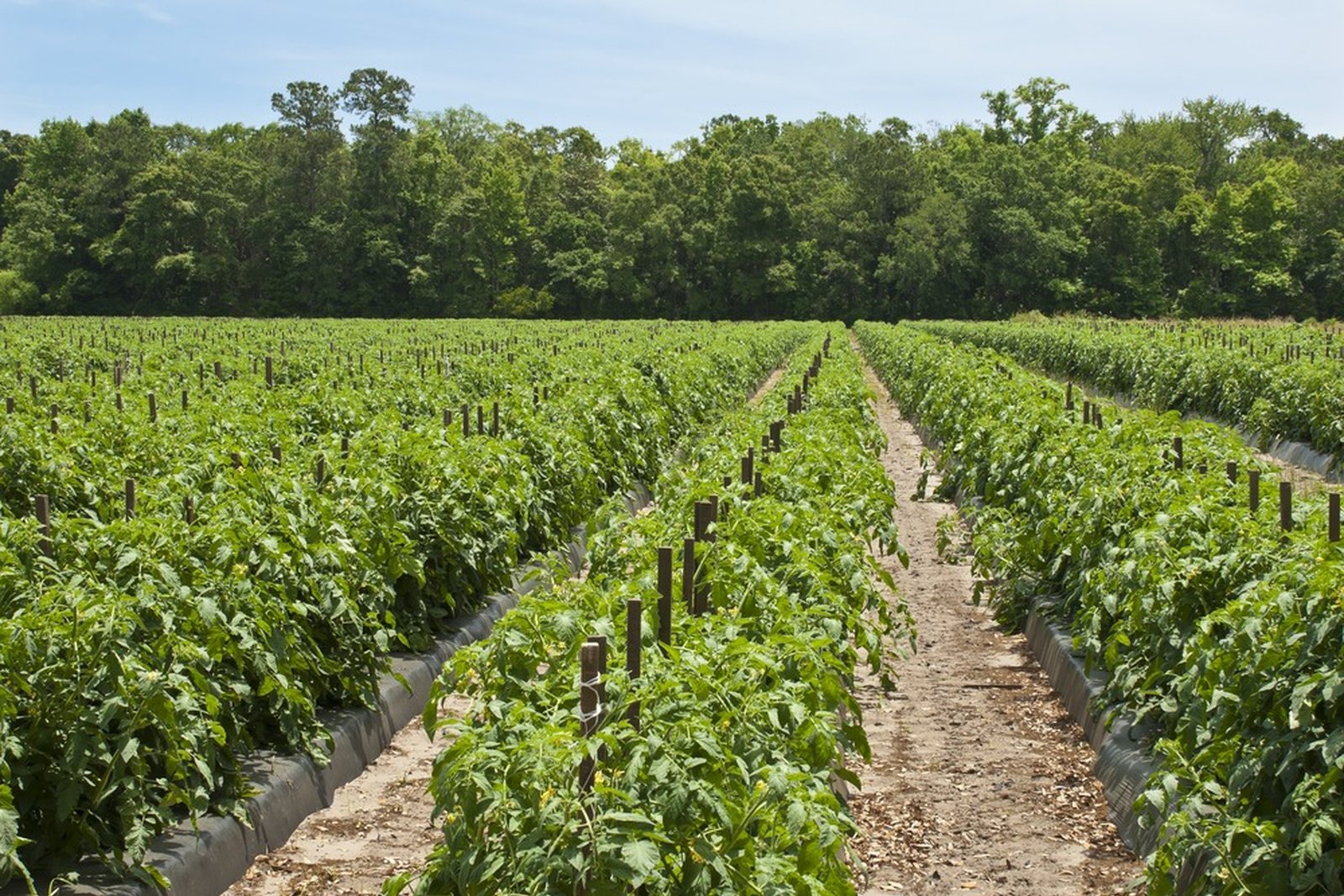
What tomato suckers are and when to remove them
A sucker is a shoot arising from the angle between a leaf and the main stem. On an indeterminate plant, a sucker can become another full leader with flowers and fruit.
Remove suckers when:
- Training to a defined number of stems.
- The plant is too dense for the support.
- Airflow and harvest access are declining.
- A low sucker will trail on the soil.
Keep suckers when:
- Growing a lightly managed caged plant.
- The climate is hot and fruit needs leaf cover.
- The plant is determinate.
- Additional leaders are part of the production plan.
Pinch small suckers with clean fingers. Large pruning cuts create bigger wounds and remove more potential yield.
Lower-leaf pruning for soil splash and access
Once plants are established, remove leaves that touch the soil and leaves that are clearly diseased or damaged. A clean lower stem can reduce soil splash and make mulching and watering easier.
Do not strip the plant upward in one session. University of Minnesota Extension advises that early blight often starts on lower foliage, but also cautions against removing more than about one-third of the leaves. The goal is a healthy canopy with airflow, not a bare stem carrying exposed fruit.
One stem, two stems, or a fuller cage
One-stem training creates a narrow plant and can work in high-density protected systems. It requires regular pruning and dependable support.
Two-stem training preserves more leaf area and fruiting sites while remaining organized. Select one strong sucker below or near the first flower cluster as the second leader.
Multi-stem cage culture uses more horizontal space and less pruning labor. It often suits home gardens where the cage is strong and spacing is generous.
There is no universal winner. The right system balances yield per plant, yield per bed, fruit size, disease pressure, sun exposure, and labor.
Why hot climates need a different pruning instinct
Leaves protect fruit from intense sun. Over-pruning can cause sunscald: pale or white areas on exposed fruit that later become vulnerable to rot.
In hot, bright climates, preserve more canopy than a cool-climate greenhouse tutorial may recommend. Prune for airflow at the base and interior without opening every fruit cluster to afternoon sun.
If disease has already removed much of the canopy, aggressive pruning can make the remaining fruit more vulnerable.
How to tie without injuring the stem
Use soft ties, clips, or twine intended for plants. Tie loosely in a figure-eight or with room for stem expansion. Check ties during rapid growth.
Support fruiting branches before they split. Large heirloom slicers may need slings or multiple attachment points. Never hang the full weight of a cluster from one brittle branch.
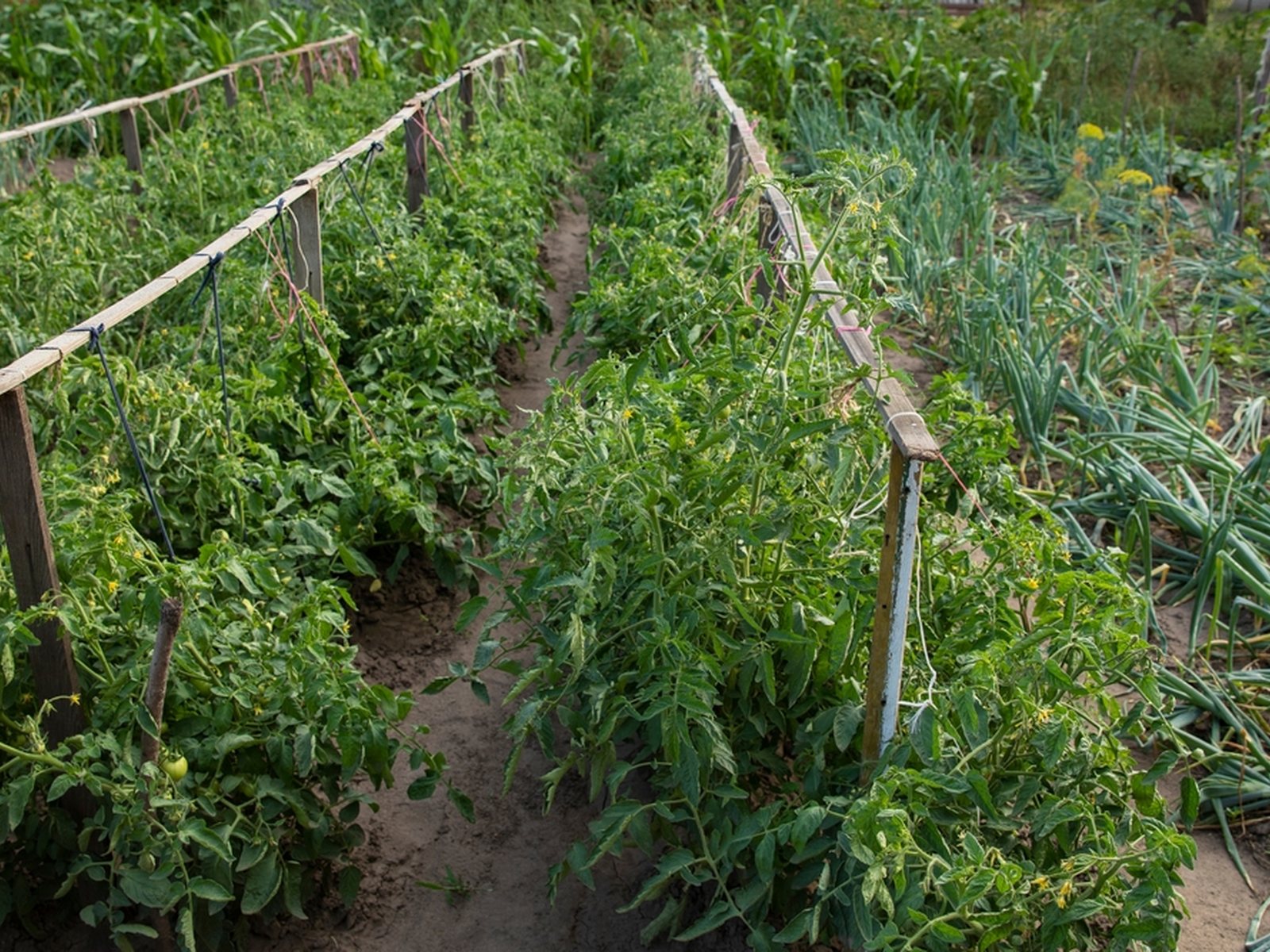
Support as disease prevention - and its limits
Staking and trellising keep foliage off soil, improve airflow, and make infected leaves easier to remove. They help manage early blight and other leaf diseases, but they do not create immunity.
Combine support with:
- Mulch to reduce splash.
- Soil-level watering.
- Adequate plant spacing.
- Crop rotation.
- Tool sanitation.
- Resistant varieties where available.
- Prompt diagnosis.
Pruning wet plants can spread disease. Wait until foliage is dry.
A practical weekly tomato routine
- Check ties and clips.
- Guide new growth into the cage or trellis.
- Remove leaves touching soil.
- Inspect lower foliage for spots.
- Decide whether new suckers fit the training plan.
- Check moisture beneath the mulch.
- Support heavy fruit clusters.
- Harvest ripe fruit before cracking, birds, or storms take it.
Ten focused minutes per plant can prevent an hour of rescue after vines collapse.
Build and test support for the worst week of the season
A support system should be judged in the week when the foliage is wet, the vines are heavy, the fruit is nearly mature, and a storm is pushing from the side. That is why I check post depth, wire gauge, anchor points, and the path I will use to harvest before the plant reaches full size.
For a cage, push and pull it after installation. If the cage rocks in dry soil, it will not improve when the soil is saturated. For a stake, make sure the lower end is deep enough and the above-ground height matches the final plant. For a Florida weave, place strong end posts, maintain tension, and add each new line before the canopy falls outward.
- Leave room for the stem to expand inside every tie or clip.
- Keep ties below a strong leaf or branch junction when possible so the vine cannot slide.
- Do not bind several heavy leaders to one weak point.
- Add support under large clusters before the branch creases.
- Disinfect reusable clips and stakes after a season with bacterial or fungal disease.
Pruning should reduce a specific problem. Remove soil-touching leaves to limit splash, interior leaves only when airflow is genuinely poor, and suckers according to the number of leaders the support can carry. In the hot Southeast, a fuller canopy often protects fruit better than a stripped one-stem plant. The right question is not how much can be removed, but how much healthy leaf area the crop needs to ripen without hiding disease or collapsing into the row.
Write the system on the plant label. A note such as two leaders, cattle panel, lower eight inches cleared is enough to keep midseason work consistent. Without that record, pruning gradually becomes random, especially when several people care for the same garden.
Choose the training system before the plant chooses it for you
A one-leader stake system gives a narrow, accessible plant but requires frequent pruning and tying. A large cage allows more leaders and less pruning but needs more horizontal space. Florida weave is efficient for rows, but weak end posts or delayed twine can allow the whole row to fall.
The best system is the one that can be maintained during peak season, not the one that looks most elegant at transplanting.
| What you observe | Most useful next check | Action that follows the evidence |
|---|---|---|
| A determinate plant is crowded inside a cage | Check whether healthy suckers were removed unnecessarily | Open access by removing damaged or soil-contact foliage, not the crop-bearing framework. |
| An indeterminate vine has six unmanaged leaders | Choose the leaders that fit the support and remove small extras gradually | Avoid stripping large mature stems in one day during hot weather. |
| Fruit is sunscalding after pruning | Check how much leaf area was removed and which side receives afternoon sun | Preserve or restore shade with less aggressive pruning and temporary protection. |
| Stems are girdled at ties | Inspect every tie after rapid growth | Replace with soft wider ties and leave expansion space. |
Design tomato support for the heaviest week of the season
This guide explains how to prune tomatoes only after the support system and plant habit are known. It compares tomato cages, when to stake tomato plants, Florida weave tomatoes, tomato trellis construction, tomato suckers, and determinate vs indeterminate pruning.
A transplant weighs very little. A mature tomato plant after rain may carry wet foliage, several fruit clusters, and wind load. The support system should be selected for that condition. University Extension guidance for staked indeterminate tomatoes commonly uses stakes 6 to 7 feet long, driven about a foot into the soil. Determinate plants may use shorter stakes, but a concentrated crop can still require substantial strength.
- Install stakes, cages, or trellises at transplanting.
- Use stronger end posts than intermediate supports.
- Place supports so the first flower cluster is not trapped against a stake.
- Inspect attachment points after storms.
- Do not rely on light conical cages for large indeterminate plants.
- In containers, anchor support to the structure or ground rather than only to potting mix.
Good support improves access, keeps fruit off wet soil, and can help foliage dry. It does not replace spacing, sanitation, diagnosis, or root-zone irrigation.
Tomato cages, stakes, trellises, and Florida weave compared
| System | Best fit | Pruning level | Main advantage | Main limitation |
|---|---|---|---|---|
| Heavy cage | Determinate, dwarf, or full-canopy indeterminate plants | Low | Preserves foliage and multiple fruiting stems | Uses more width and must be strong |
| Single stake | Closely spaced indeterminate plants | Moderate to high | Narrow footprint and easy harvest access | Frequent tying and greater sunscald risk |
| Two-leader stake or string | Indeterminate plants where balance is desired | Moderate | More canopy and crop than one leader with controlled structure | Requires early leader selection |
| Panel trellis | Garden rows and long-season vines | Low to moderate | Reusable and easy to tie from both sides | Needs strong posts and storage space |
| Florida weave | Rows of determinate or semi-determinate tomatoes | Low to moderate | Efficient row support | Requires repeated weaving and strong end posts |
| Overhead string | High tunnels and protected structures | Moderate to high | Vertical use of space | Requires rated overhead structure and regular training |
Choose before planting. A cage system invites more stems and a fuller canopy. A stake system requires deciding which leaders remain. Switching in midsummer usually means broken stems and emergency ties.
How to build and maintain a Florida weave
Penn State recommends spacing tomatoes about 18 to 24 inches in the row and driving a stake between every second or third plant, with stronger posts used regularly and at row ends. Rutgers field guidance commonly uses stakes about 6.5 feet long driven 12 to 14 inches. Home-garden materials may differ, but the engineering principle is the same: strong ends, adequate depth, and string added before plants fall.
- Install sturdy end posts and intermediate stakes at planting.
- Begin the first string when plants are roughly 10 to 12 inches tall.
- Tie at one end, pass the string along one side of the first plant, around the stake, then along the opposite side of the next plant.
- Continue alternating so the row is held between string paths.
- Return along the row to complete a supportive layer.
- Add a new layer every 6 to 10 inches of growth, before stems lean heavily.
- Retighten after rain and replace frayed string.
Use a material strong enough for the row but not so thin that it cuts stems. Do not cinch string around individual stems. The weave supports the plant mass between stakes.
What is a tomato sucker?
A sucker is a shoot that forms in the angle between a leaf petiole and the main stem. It can become a full stem with leaves, flowers, and fruit. Calling every sucker waste is biologically wrong. The pruning decision depends on plant habit and support.
| Plant habit | Pruning approach | Reason |
|---|---|---|
| Determinate | Usually remove only damaged, ground-touching, or obstructive growth | Many branches contribute to the concentrated crop |
| Indeterminate, heavy cage | Minimal selective pruning | The cage is designed to carry multiple stems |
| Indeterminate, one stake | Remove most suckers while small | One leader must fit the narrow support |
| Indeterminate, two leaders | Keep main stem and one selected sucker below the first flower cluster | Creates a balanced two-stem structure |
| Dwarf | Generally little pruning | Short internodes and sturdy architecture do not require one-stem training |
| Micro | Do not prune for size | The plant is already genetically compact |
Remove suckers when they are small enough to pinch cleanly. Large cuts create wounds and remove productive leaf area. Use clean tools when a cut is required, and avoid handling wet plants when disease spread is a concern.
A tomato pruning calendar by crop stage
| Stage | Pruning and support work | Do not do |
|---|---|---|
| Transplant | Install support; remove only buried or damaged leaves | Strip a small transplant to a bare stem above soil |
| Early vegetative growth | Select leaders for stake systems and add first ties | Wait until stems are thick and tangled |
| First flower clusters | Continue tying; remove lower leaves touching soil | Remove the healthy leaf directly supporting every cluster |
| Rapid summer growth | Weekly sucker decisions and new support layers | Perform one severe catch-up pruning |
| Heavy fruit load | Support individual branches if needed | Tighten ties against expanding stems |
| Hot weather | Preserve canopy over fruit | Expose green fruit suddenly to intense sun |
| Late season | Remove clearly diseased tissue and consider topping only when frost timing justifies it | Assume topping instantly ripens immature fruit |
Remove lower tomato leaves for a reason, not a fixed height
Lower leaves touching soil are exposed to splash and are difficult to inspect. Removing them can improve access and reduce contact with contaminated soil. Some Extension guidance suggests clearing the lowest 8 to 10 inches once plants are established and tall enough. The correct amount depends on plant size, disease pressure, and how much healthy canopy remains.
Prioritize:
- Leaves touching soil or mulch.
- Leaves with confirmed disease that can be removed without severe defoliation.
- Leaves blocking airflow at the base or irrigation access.
- Broken or storm-damaged tissue.
Do not remove more than roughly one-third of the foliage at once. Sudden defoliation can expose fruit and stress the plant. If disease has already destroyed most leaves, pruning is not a substitute for diagnosis and a broader management decision.
Tie tomato stems without girdling them
- Use soft cloth, horticultural tape, wide twine, or purpose-made clips.
- Create a loose figure-eight between support and stem when tying by hand.
- Place ties below a leaf node or cluster where the stem cannot slide easily.
- Leave room for stem expansion.
- Support the branch, not the fruit truss alone, when fruit becomes heavy.
- Inspect ties every one to two weeks.
Never use thin wire directly around a living stem. A tie that looks loose in June can girdle the plant in July. Remove abandoned clips and string at season end so they do not become debris or disease reservoirs.
Prune differently in hot, humid gardens
In humid climates, gardeners want airflow. In hot climates, fruit needs shade. The answer is selective pruning, not stripping. Open the lower canopy, maintain the chosen leaders, and remove crowded shoots that cannot be supported. Preserve leaves above and around fruit clusters.
Temporary shade cloth can protect a pruned row during exceptional heat, but it should not be used to justify severe routine pruning. If late blight or another rapidly spreading disease is suspected, prioritize diagnosis and sanitation rather than cutting through the entire row with the same tool.
Support helps disease management, but it does not make a plant disease-proof
Supported plants are easier to inspect and keep off wet soil. Improved airflow can shorten leaf-wetness periods. However, spores can still arrive by wind or splash, bacterial diseases can spread during handling, and roots can fail in saturated soil.
| Support benefit | Remaining requirement |
|---|---|
| Keeps fruit off soil | Mulch and harvest sanitation |
| Improves leaf access | Weekly scouting and accurate diagnosis |
| Can improve drying | Adequate spacing and root-zone watering |
| Reduces branch breakage | Timely ties and storm inspection |
| Makes diseased leaves removable | Clean tools and avoidance of wet-plant handling |
Clean reusable supports before the next crop. Remove old plant material and soil. Sanitize according to Extension or manufacturer guidance for the material used.
Compare tomato support systems with a labor and yield record
A support system should be evaluated on usable yield, fruit quality, and labor. One leader may ripen earlier but require more tying. A cage may produce more stems but use more space. Florida weave may be efficient for a row but not for one patio plant.
| Metric | Record method |
|---|---|
| Installation cost | Materials and minutes per plant |
| Weekly labor | Minutes tying, weaving, pruning, and repairing |
| Storm damage | Broken stems, toppled supports, and lost fruit |
| Usable yield | Sound pounds per plant or bed foot |
| Sunscald | Fruit weight lost after pruning or leaf disease |
| Foliar disease progress | Weekly lower-, middle-, and upper-canopy ratings |
| End-of-season cleanup | Minutes and ability to sanitize and reuse |
The best support is the one that survives the season, fits the plant habit, and can be maintained by the people growing the crop.
Build a heavy tomato cage that can be reused
University of Minnesota Extension recommends concrete reinforcing mesh as a durable cage material. A section roughly 56 to 60 inches long forms a cage about 18 inches in diameter. The large openings allow hands to reach fruit and stems.
- Wear gloves, long sleeves, and eye protection.
- Cut mesh with bolt cutters or heavy wire cutters.
- Join the cut edges with strong wire or bent hooks.
- Place the cage at transplanting.
- Drive two stakes inside opposite sides of the cage.
- Tie cage to stakes before the plant becomes heavy.
- At season end, remove debris and sanitize before storage.
An 18-inch cage is suitable for many plants but not every vigorous heirloom. Wider cages preserve more stems and require more bed spacing. Never assume cage diameter and plant spacing are independent.
Tomato pruning myths that reduce yield or fruit quality
| Myth | More accurate rule |
|---|---|
| Every sucker steals energy | A sucker becomes a productive stem; remove it only when the training system cannot support it |
| Determinate tomatoes should be single-stemmed | Most determinate plants should retain branches carrying the concentrated crop |
| More pruning always improves airflow | Severe leaf loss can expose fruit and stress the plant without correcting spacing or wet foliage |
| Topping makes all green fruit ripen | Topping stops new growth but cannot make immature fruit physiologically mature |
| Leaf roll means the plant needs pruning | Physiological leaf roll is often associated with pruning and stress |
| A cage means no inspection is needed | Dense cage interiors still require scouting and ties |
Repair tomato support after wind or heavy rain
- Wait until electrical and weather hazards have passed.
- Support the root ball and upright a leaning plant gradually.
- Add an external stake rather than forcing a damaged cage deeper through roots.
- Remove fully broken stems with clean tools.
- Splint partially cracked stems only when the branch is valuable and can be held without constriction.
- Harvest heavy mature fruit to reduce load.
- Inspect ties for girdling and add support below fruit clusters.
- Photograph damage and update the support design for next year.
A plant with major stem injury should not be subjected to severe additional pruning. Preserve enough foliage for recovery.
Compare support systems per bed foot, not only per plant
A widely caged plant may yield more per plant but fewer plants fit the bed. A closely staked row may yield less per plant but more per bed foot. Include labor and losses.
| Metric | Formula |
|---|---|
| Usable yield per plant | Sound pounds divided by plants |
| Usable yield per bed foot | Sound pounds divided by row feet |
| Labor per pound | Total support and pruning minutes divided by usable pounds |
| Sunscald loss | Sunscalded weight divided by total harvest x 100 |
| Disease loss | Fruit and crop lost to confirmed disease divided by total potential harvest |
| Material life | Years of safe reuse |
This prevents a visually tidy single-stem system from winning when it requires excessive labor or loses fruit to exposure.
Detailed questions about pruning and supporting tomatoes
Should I remove all tomato suckers?
No. Suckers become productive stems. Remove them when a one- or two-leader system requires it. Determinate, dwarf, and caged plants usually keep more suckers because those branches carry fruit.
When should tomato plants be staked?
At transplanting. Driving stakes later can damage roots and large plants are harder to straighten. Begin ties or weave layers while plants are about a foot tall.
How tall should tomato stakes be?
Penn State recommends 6-to-7-foot stakes for indeterminate varieties and about 4 feet for determinate varieties, driven roughly one foot into soil. Exposed height therefore is less than total stake length.
Does pruning prevent tomato disease?
Selective pruning can improve access and drying, but it does not prevent infection by itself. Spacing, mulch, root-zone irrigation, sanitation, diagnosis, and resistant varieties remain necessary.
Can tomatoes be overpruned?
Yes. Excess pruning removes photosynthetic area and exposes fruit to sunscald. Avoid removing more than about one-third of foliage at once and preserve leaves around developing fruit in hot weather.
Is Florida weave good for indeterminate tomatoes?
It can support a row, especially when stakes and repeated string layers are strong, but very vigorous indeterminate plants may outgrow a low system. Use tall stakes, strong end posts, and regular weaving.
Why is my tomato cage falling over?
The cage may be too light, too narrow, or poorly anchored. Add stakes on opposite sides and tie the cage to them. In containers, anchor to an external structure rather than only to potting mix.
Should lower tomato leaves be removed?
Remove leaves touching soil, confirmed diseased leaves, and growth blocking access after the plant is established. Do not strip the base of a small transplant or remove healthy canopy without a reason.
Pruning tool and clip sanitation
Begin with visibly clean tools. Soil and plant sap reduce sanitizer performance. Remove debris, wash, then use a product and contact time appropriate for the tool material. Keep a clean tool for healthy plants and a separate tool or disinfection step after suspect plants. Disposable clips should not move from a diseased row to a clean row.
Prune when foliage is dry. Work from healthiest plants toward questionable plants. Place diseased tissue directly into a container rather than dropping it in the path. Wash hands before handling fruit or moving to another planting.
Choose support materials by service life and failure mode
| Material | Strength | Failure to watch |
|---|---|---|
| Wood stake | Easy to source and tie | Rot at soil line and breakage in wet wind |
| Metal T-post | Strong end or intermediate support | Sharp edges and heat; use safe ties |
| Reinforcing mesh | Long-lived heavy cage | Sharp cut ends and difficult storage |
| Plastic twine | Strong Florida weave | Stem cutting and persistent waste |
| Natural twine | Easy cleanup | Stretching and rot in wet weather |
A five-minute weekly support inspection
- Look for leaning posts and loose anchors.
- Check ties below every heavy cluster.
- Remove or loosen ties cutting into stems.
- Add the next weave layer before growth falls outward.
- Remove leaves touching soil and photograph suspicious lesions.
- Harvest heavy ripe fruit before storms.
- Record repair time and failures.
Regular small adjustments prevent emergency pruning and broken branches.
Frequently asked questions
Should I prune determinate tomatoes?
Only lightly. Remove damaged, diseased, or soil-touching leaves, but heavy sucker pruning can remove much of the plant's planned crop.
Should I remove every sucker from an indeterminate tomato?
No. Remove suckers according to the chosen training system, climate, spacing, and labor. A caged plant may keep several leaders.
Are cages or stakes better?
Cages require less pruning and preserve canopy. Stakes use less space but demand more tying and training.
How tall should a tomato cage be?
Match the variety. Vigorous indeterminate tomatoes often outgrow common short cages; use a strong cage or trellis six feet or taller.
Can pruning prevent blight?
It can reduce soil contact and improve airflow, but it cannot prevent every infection. Use mulch, spacing, rotation, sanitation, and diagnosis too.
Why are my tomato stems splitting at ties?
Ties may be too tight, too narrow, or not adjusted during rapid growth. Use soft material and allow expansion.
When should lower leaves be removed?
After the plant is established and tall enough that removing the lowest leaves will not leave it bare. Remove soil-touching or diseased leaves first.
Can over-pruning reduce yield?
Yes. It removes leaf area and potential flowering shoots and can expose fruit to sunscald.
Editorial note: Pruning recommendations depend on plant habit, climate, support, and production system. Avoid presenting one-stem greenhouse training as the default for every home garden.