Variety field guide
What to expect from Garden Huckleberry Garden huckleberry Seeds
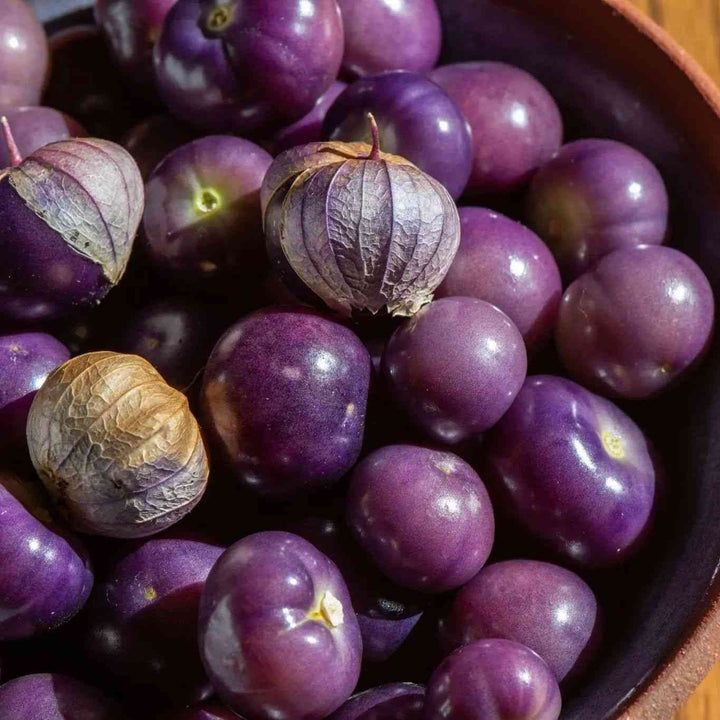
Garden Huckleberry seeds grow into bush plants about 31–36 in, bearing black Small berry clusters; verify current seed lot.
Read the complete product descriptionTraits, flavor, garden use, variety notes, and the full catalog record
Garden Huckleberry Seeds produce a productive heirloom nightshade grown for its clusters of deep purple-black berries traditionally cooked into pies, jams, and preserves.
Food safety warning: Garden huckleberry is a nightshade. Do not eat green, partially ripe, or firm unripe berries, and do not eat leaves, stems, or other green plant parts. Unripe fruit can contain higher levels of naturally occurring glycoalkaloids and may be toxic. Harvest only berries that are fully deep purple-black and slightly soft. This product is intended for the traditional cooked use of fully ripe fruit. Cooking is not a substitute for full ripeness. If there is any doubt about ripeness or plant identity, do not consume it.
Botanical-name note: Alliance maintains this seed lot under Solanum melanocerasum. Many current taxonomic authorities treat S. melanocerasum as a synonym of Solanum scabrum, so both names may appear in botanical references.
Garden huckleberry, Solanum melanocerasum, is a productive annual fruiting plant in the nightshade family grown for its clusters of small, glossy black berries. The plants resemble large black nightshade plants, forming bushy, upright growth that can reach around 2 to 3 feet tall. Broad green leaves and branching stems produce clusters of white star-shaped flowers, which develop into round berries that ripen from green to deep purple-black.
The berries are typically harvested when fully ripe and soft. Unlike many berries that are eaten fresh, garden huckleberries are traditionally cooked. When prepared into pies, jams, preserves, or syrups, they develop a rich flavor that has long made them a staple in old-fashioned homestead cooking.
Despite the name, garden huckleberry is not the same plant as the wild huckleberries many people are familiar with. The name “huckleberry” is a common name applied to several unrelated plants. True huckleberries belong to the genera Vaccinium or Gaylussacia and grow as perennial shrubs, often found in woodland environments. Garden huckleberry, by contrast, is an annual nightshade grown much like tomatoes or peppers.
Because of this shared common name, the plants are often confused with one another. Garden huckleberry is botanically closer to crops like tomatoes and eggplants than it is to blueberries or true huckleberries.
Gardeners grow this plant for its heavy yields and its usefulness in cooked dishes. Once established, the plants branch freely and produce numerous berry clusters throughout the growing season, making them a reliable and interesting addition to edible gardens.
When growing Garden Huckleberry Seeds, plan for annual, bush, about 31-36 in tall. It is botanically recorded as Solanum melanocerasum, listed as Open-Pollinated (OP), described in the catalog as Heirloom. Support is listed as No-Support.
The recorded growing reference for Garden Huckleberry Seeds is planting season Spring; seed depth 1/4 in; germination temperature 70-85 °F; expected emergence 7-14 Days; light Full sun; plant spacing 24 in; soil Loamy; soil pH 6.5-7.0; water Moderate. Use those values with local frost dates, soil temperature, and weather rather than treating a calendar date as universal.
Choose Garden Huckleberry Seeds for warm-season kitchen gardens, supported plants, fresh harvest, and preserving. Harvest at 110-119 Days, adjusted for weather and the stage you intend to use. The detailed sections below cover fresh eating, cooking, preserving, specialty harvest, and seed saving according to crop type, common problems, and how to carry the variety forward without reducing the page to a generic crop description.