Corn diseases and disorders overlap in ways that make quick visual labels dangerous. Drought can gray a canopy like leaf blight. Nutrient deficiencies can stripe or yellow leaves. Insects can open ears for mold. Smut is unmistakable once large galls form, but early leaf lesions, stalk weakness, and ear rots often require the whole plant, weather history, and field pattern to separate.
The first job is triage: decide whether the main problem is on leaves, ears, stalks, roots, or the entire plant; whether it began low or high; and whether it follows residue, drainage, wind, insects, or a spray pattern. Then compare the symptom with an Extension description or send a sample to a diagnostic clinic.
This guide covers common smut, rust, northern corn leaf blight, gray leaf spot, other leaf spots, ear rots, stalk rots, and non-disease look-alikes. It is written for home gardens and small seed plots, where preserving clean seed and keeping questionable grain out of the kitchen are as important as saving the current crop.
Start with symptom type and pattern
A diagnosis starts with location. Leaf diseases create lesions or pustules. Ear rots create mold or decay on kernels and cob. Stalk rots weaken or discolor the rind and pith. Root problems affect anchorage and whole-plant vigor. Abiotic disorders often follow soil, weather, or application patterns more clearly than infectious diseases.
Next ask whether the symptom is spreading. A disease may begin in a small area and expand after wet weather. A nutrient deficiency may appear uniformly in similar soil. Herbicide drift often affects the exposed edge and produces distorted new growth. Drought follows shallow soil, tree roots, missed irrigation, or the driest part of the bed.
| Question | Why it matters |
|---|---|
| Did symptoms begin on lower or upper leaves? | Several residue-borne diseases begin low and move upward |
| Are lesions limited by leaf veins? | Rectangular vein-limited lesions suggest gray leaf spot |
| Do spots rub off as powder? | Rust pustules release spores; tar spot does not rub away easily |
| Is there insect feeding or a wound? | Wounds can precede ear rot, stalk rot, or smut |
| Do only one variety or planting date show symptoms? | Resistance, maturity, and weather timing may differ |
| Does the pattern follow irrigation or a low spot? | Root stress and prolonged wetness may be primary |
| Are ears intended for food or seed? | Food safety and seed sanitation require stricter separation |
Do not apply a fungicide because a leaf is brown. Fungicides do not correct drought, nutrient deficiency, herbicide injury, insect feeding, or advanced stalk decay. Some diseases are best managed with resistant varieties and rotation, and some home-garden infections occur too late to justify treatment.
Scout the whole plant and the whole block
Begin at the block edge and walk a pattern that crosses the center, low areas, dry areas, and different varieties. Count affected plants rather than using words such as “everywhere.” Record the percentage of plants and which leaves are involved. A few lower lesions on mature corn are a different problem from rapid upper-canopy loss before silking.
Photograph the entire plant, the front and back of a symptomatic leaf, the ear with husk position intact, and a healthy comparison plant. Include a ruler or coin for scale. Record planting date, variety, stage, rainfall, irrigation, fertility, recent sprays nearby, and whether corn or sorghum grew in the same bed last year.
Use a hand lens. Rust pustules, fungal structures, insect eggs, frass, and small lesions can look like dirt from a distance. Rub suspected rust gently with a white tissue. Powdery spores may transfer. Do not rub moldy ears and then handle clean seed ears.
- Map the symptom pattern before removing plants.
- Separate plants or ears intended for seed from any suspect material.
- Look inside the whorl, under leaves, at the stalk base, and beneath the husk.
- Check whether lesions cross veins or remain rectangular between them.
- Open a small number of representative ears and inspect tip, base, and insect wounds.
- Submit a sample when symptoms do not match a reliable description or when the seed line is valuable.
Common corn smut
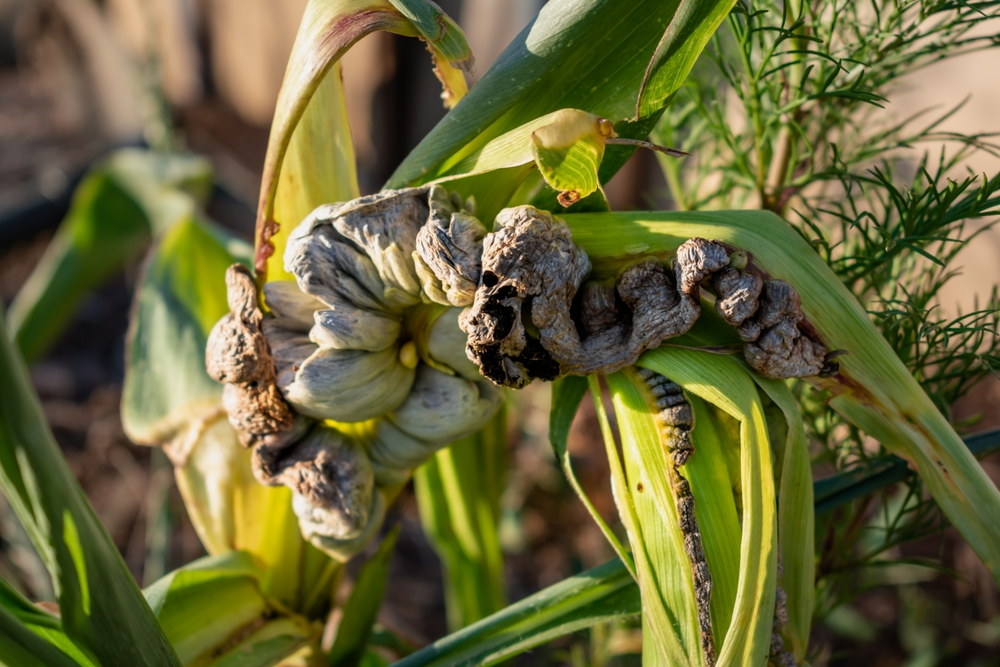
Common smut is caused by Ustilago maydis. It can affect ears, tassels, leaves, and stalks. Young galls are firm and pale green to white. As they mature, they become gray or purplish and eventually rupture, releasing masses of black powdery spores.
Wounded, rapidly growing tissue is especially vulnerable, and humid rain followed by dry sunny weather can favor infection. Hail, cultivation injury, insect feeding, and mechanical damage may increase the number of infection sites. High nitrogen and susceptible varieties can also contribute.
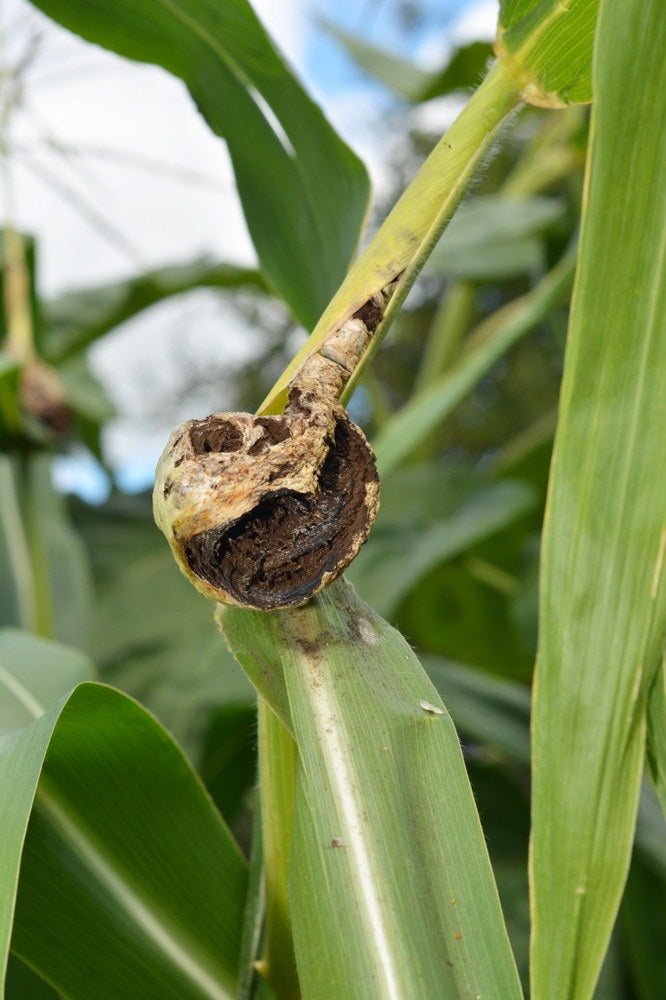
In a home seed plot, inspect throughout the season and remove galls before they rupture. Place them in a bag and dispose of them away from the corn area. University of Minnesota advises against composting smut galls because spores can survive and return to the planting. Rotate away from corn, reduce injury, and choose less susceptible varieties when smut repeats.
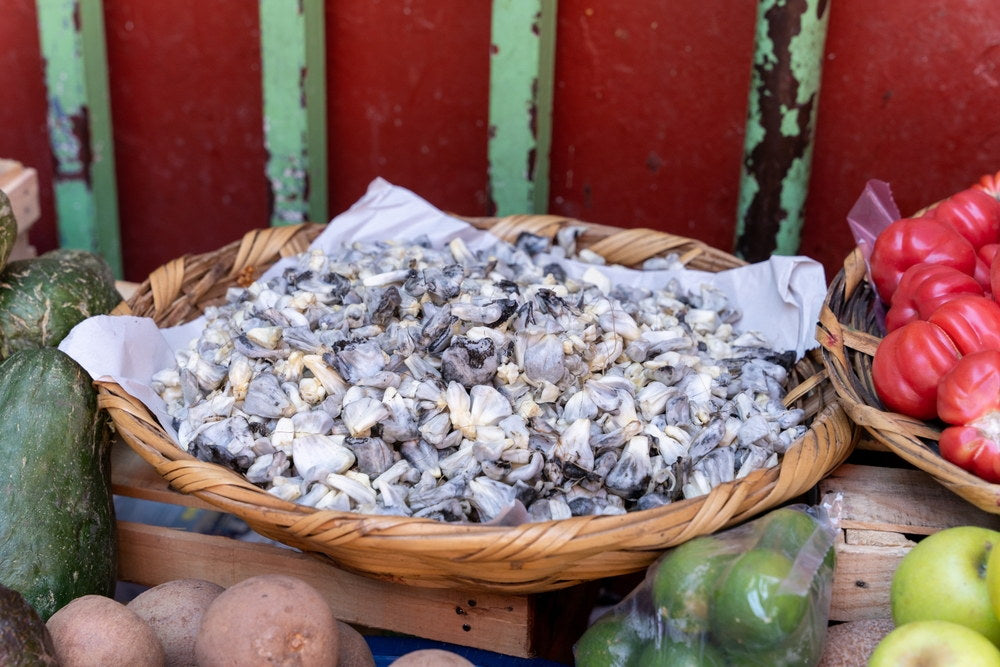
Corn smut is also used as food in Mexican cuisines under names including huitlacoche. That culinary use does not make every unidentified gall safe or appropriate to eat. A grower who intends to harvest it should use a reliable identification and food-handling source rather than treating a disease guide as a recipe.
| Smut stage | Appearance | Garden action |
|---|---|---|
| Young | Firm pale swelling | Confirm identification; remove if protecting the crop |
| Expanding | Gray or purplish gall | Bag and remove before rupture |
| Mature | Dry gall releasing black powder | Avoid spreading spores; remove surrounding debris |
| Next season | Spores persist in residue and soil | Rotate, reduce wounds, and select less susceptible varieties |
Common rust and southern rust
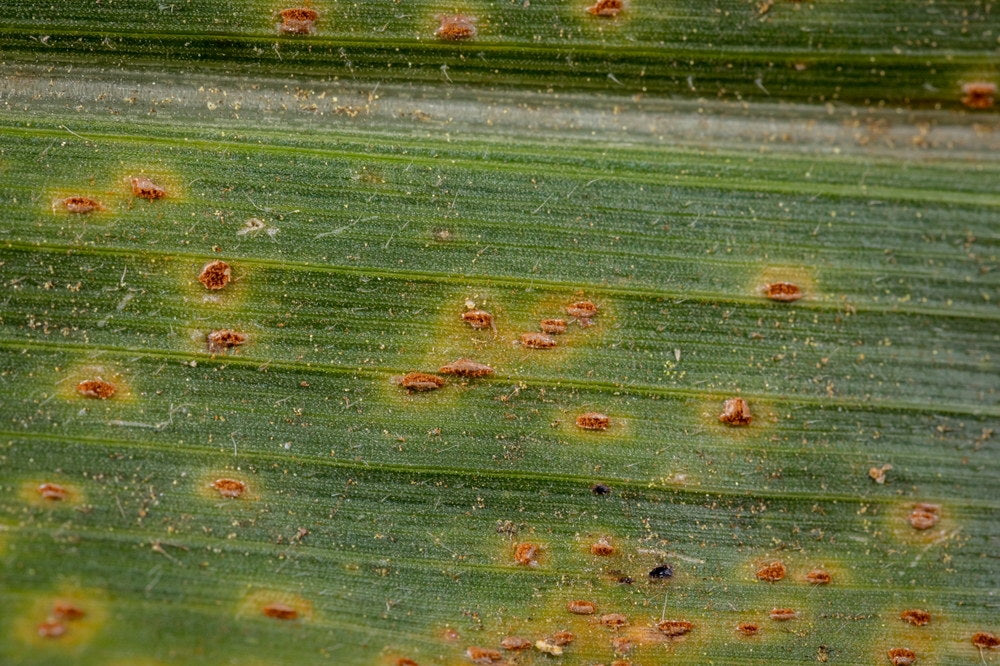
Common rust is caused by Puccinia sorghi. It usually begins as yellow flecks that develop into oval or elongated reddish-brown powdery pustules. Pustules occur on both leaf surfaces and may tear through the epidermis, giving the leaf a rough or bumpy texture. Older pustules darken toward brown or black.
Common rust is favored by cool moist weather, often around 60 to 70°F, and spores blow into northern regions from the south. Late infection may have little effect on yield, while severe early infection can reduce leaf area before grain fill. Resistant varieties are the primary management tool.
Southern rust is a different disease and can be more aggressive in warm conditions. Its pustules are often smaller, more orange, and concentrated on the upper leaf surface, but field diagnosis can be difficult. If rust is severe, early, or unusual for the region, send a sample rather than relying on color alone.
Rust should not be confused with orange insect eggs, soil splash, or nutrient flecks. A hand lens and the powdery raised pustule are important clues. A fungicide decision depends on the disease, crop stage, severity, susceptible variety, and local label. A late spray cannot replace leaf area already lost.
Northern corn leaf blight
Northern corn leaf blight is caused by Exserohilum turcicum. Cornell describes the classic lesions as large, elliptical, cigar- or boat-shaped areas roughly one to six inches long. Young lesions may be gray-green and become tan or brown as they age. They usually begin on lower leaves and move upward.
The disease is favored by moderate temperatures, roughly 65 to 80°F, and extended leaf wetness. Cornell notes that infection and spread are promoted when leaves remain wet for at least six hours. Spores survive on infested corn residue and move by wind and rain.
Timing controls impact. Defoliation before tasseling or early grain fill can reduce ear fill and quality. Lesions that appear late, after the ear is largely filled, may look dramatic but have less effect on yield. Resistant varieties, rotation away from corn, residue breakdown, and irrigation that shortens leaf wetness form the core management plan.
| NCLB clue | What to verify |
|---|---|
| Long cigar-shaped tan lesion | Measure length and inspect both leaf surfaces |
| Begins on lower leaves | Check previous corn residue and canopy humidity |
| Dirty or dark appearance within lesion | Use a hand lens for sporulation |
| Rapid upward spread after dew or rain | Record leaf-wetness weather and variety |
| Similar to drought burn late in season | Look for distinct lesion margins rather than uniform firing |
Gray leaf spot
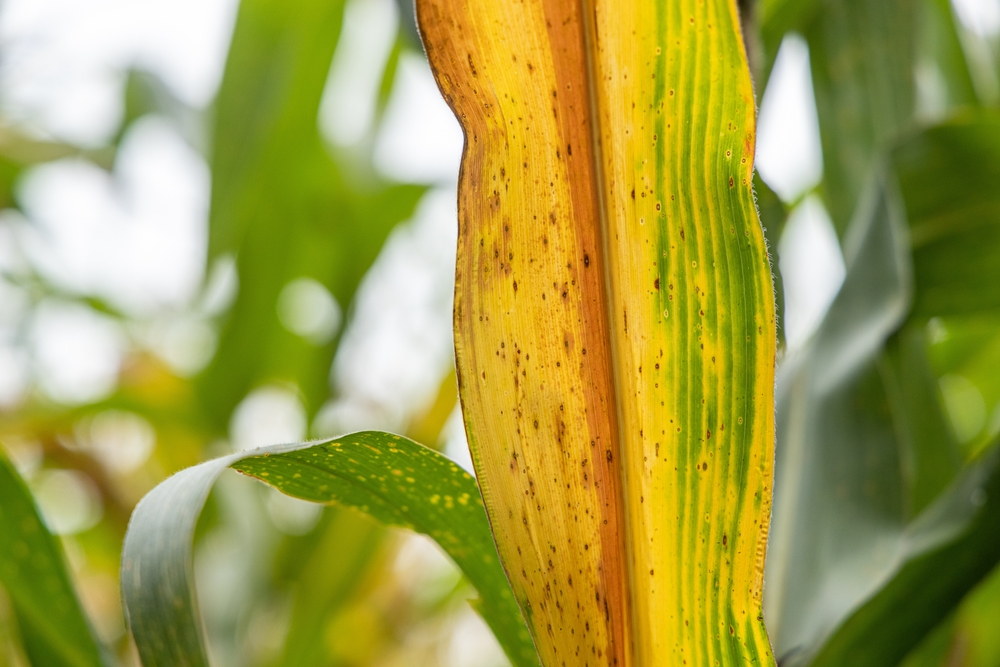
Gray leaf spot is caused by Cercospora zeae-maydis. The most useful visual clue is the lesion shape. Spots begin small, often with a yellow halo, then lengthen parallel to the veins into pale brown or gray rectangles with blunt ends. Cornell compares mature lesions to matchsticks.
Gray leaf spot is favored by warm humid weather, continuous corn, reduced residue breakdown, and valley or low-airflow microclimates. Spores develop on infected residue and move by air and rain. Lesions often begin on lower leaves, then coalesce and kill larger sections of tissue.
Do not call every gray streak gray leaf spot. Northern corn leaf blight lesions are usually larger and tapered rather than rectangular between veins. Nutrient deficiency follows veins in different patterns and usually lacks a discrete dead rectangle. Diagnostic confirmation matters when disease is early or severe.
Management centers on crop rotation, residue management where appropriate, resistant varieties, and reducing long leaf-wetness periods. In a home garden, moving corn to a new bed for several years and avoiding evening overhead irrigation often matters more than a reactive spray.
Other leaf spots and bacterial streaking
Corn can host many additional leaf diseases. Southern corn leaf blight usually produces smaller tan lesions than northern leaf blight. Eyespot creates many small circular or oval lesions with tan centers, darker margins, and a narrow yellow halo. Anthracnose leaf blight begins with water-soaked lesions that enlarge and may develop reddish-brown or yellow-orange borders.
Stewart's wilt is a bacterial disease moved primarily by corn flea beetles. Susceptible young plants may wilt or develop pale green to yellow streaks along the veins. The insect, plant stage, and variety resistance are part of the diagnosis. Fungicides do not cure a bacterial wilt.
Tar spot produces small raised black spots that look tarry and cannot be wiped away like surface dirt. It has expanded in parts of the United States and should be reported or confirmed through local Extension where it is new. Black specks inside a tan lesion can also be fungal fruiting bodies from another disease, so location and lesion structure matter.
| Symptom | Possible problem | Distinguishing clue |
|---|---|---|
| Small round spots with yellow halo | Eyespot | Many eye-like spots, often in cool wet weather |
| Tan lesions with colored borders | Anthracnose leaf blight | Water-soaked beginning and black specks in wet weather |
| Pale streaks along veins plus beetles | Stewart's wilt | Flea beetle history and wilt on susceptible plants |
| Raised black tar-like spots | Tar spot | Spots are embedded and do not wipe off |
| Broad uniform yellowing | Nutrition or roots | No discrete expanding lesion |
Ear rots, molds, and food safety
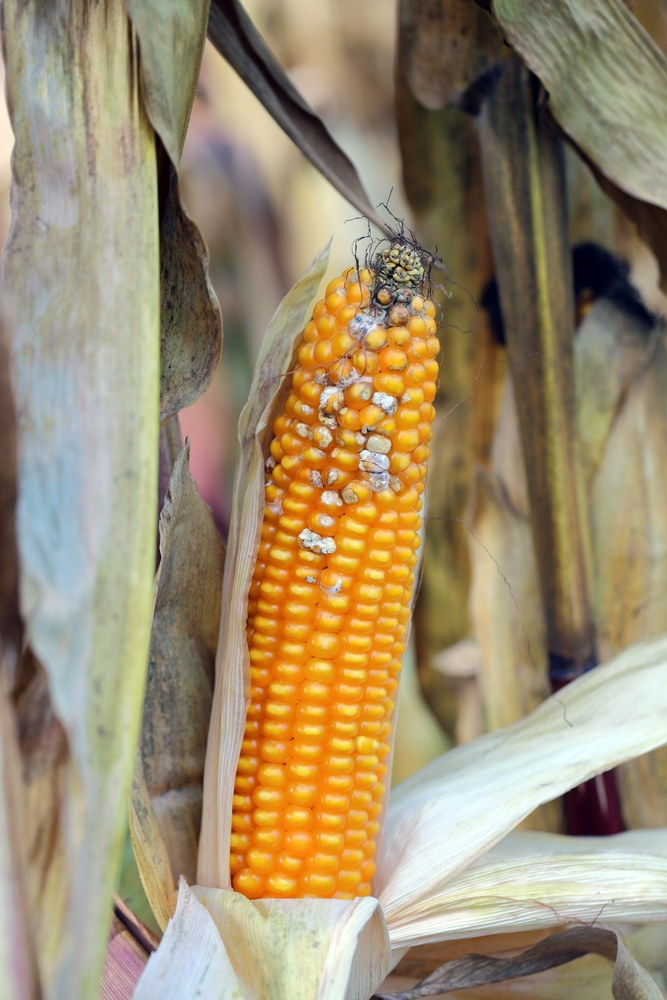
Ear rot often begins where insects, birds, hail, tight husks, prolonged rain, or delayed harvest create an opening. Fusarium ear rot may appear as scattered white to pink mold, sometimes around insect-damaged kernels. Aspergillus ear rot often produces olive-green powdery mold and is associated with hot dry conditions and stressed plants. Other molds can be white, gray, red, blue, green, or black.
Color alone does not prove the species or toxin. Some ear-rot fungi can produce mycotoxins that remain in grain even when the visible mold is removed. Do not taste questionable kernels, scrape mold away and grind the rest, or feed moldy ears to people or animals. In a small home harvest, discarding affected ears is usually the safest response. Larger food or feed lots require representative sampling and laboratory testing.
Iowa State notes that aflatoxin production is associated with Aspergillus and is favored by warm conditions and certain grain moisture levels. The presence of Aspergillus-like mold does not automatically prove aflatoxin, and the absence of visible mold does not guarantee a tested lot. Testing, not appearance, answers the toxin question.
- Separate moldy ears immediately from sound food and seed ears.
- Wear appropriate protection if handling dusty mold and work in ventilation.
- Do not shell moldy ears into equipment used for clean seed without cleaning it afterward.
- Record field location, insect injury, weather, and variety.
- Discard small questionable home-garden lots or send representative samples for testing when the quantity or seed value justifies it.
- Dry sound corn promptly to the moisture appropriate for its intended storage use.
Never save visibly moldy kernels as seed. Even when they germinate, seedborne or surface contamination can move problems into storage and the next planting.
Stalk rots, lodging, and weak plants
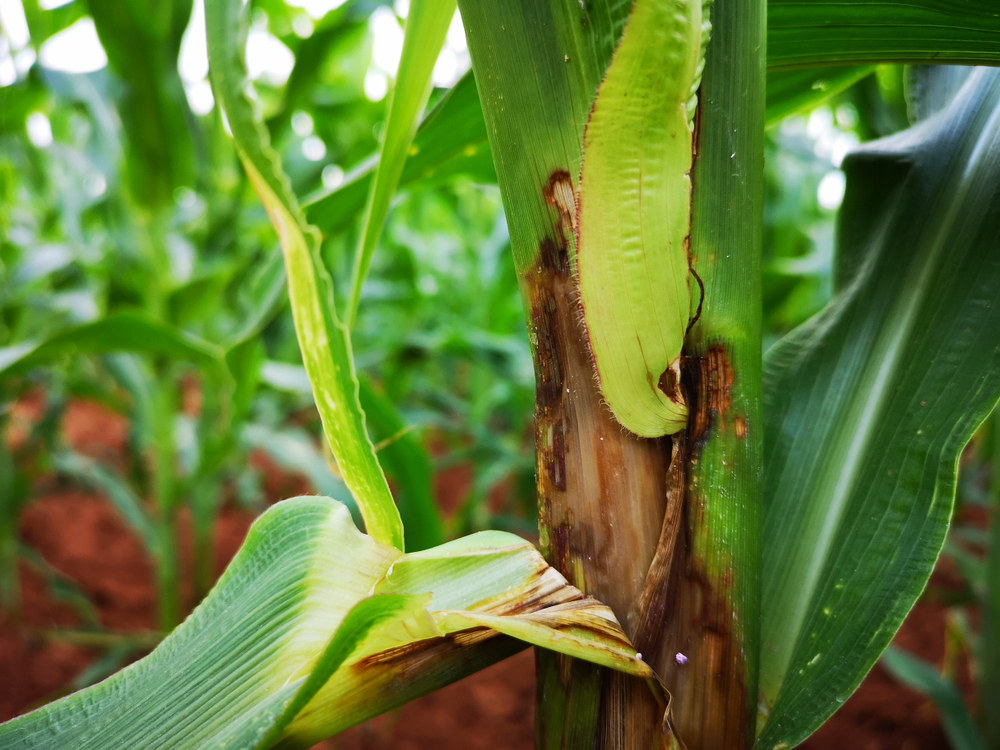
Stalk rot often becomes obvious late, when plants lean or break below the ear. Anthracnose stalk rot can create dark shiny lesions on the stalk and brown to black discoloration inside. Bacterial stalk rot can produce soft, water-soaked tissue and a strong odor. Other fungi weaken the pith after stress, insect tunneling, or premature leaf loss.
The stalk is the transport system holding the ear. Drought, flooding, high plant density, nutrient imbalance, insect injury, and severe leaf disease can all predispose the plant to lodging even when a pathogen is involved. A diagnosis should therefore include both the organism and the stress that made the plant vulnerable.
Walk the block before harvest and gently push representative stalks. Stalks that collapse or feel hollow are at higher risk of lodging. Harvest sound ears from weak plants promptly, but do not save seed from plants that lodged or rotted unless the damage is clearly external and the stewardship plan justifies it. Strong stalks are part of the variety record.
| Stalk clue | Possible cause |
|---|---|
| Shiny black external lesions and dark pith | Anthracnose stalk rot |
| Soft wet tissue with odor | Bacterial stalk rot |
| Hollow pith and lodging after drought | Multiple stalk-rot fungi or stress senescence |
| Tunnel and frass inside stalk | Corn borer or other stalk-feeding insect |
| Root plate tipped but stalk intact | Root lodging from wind or saturated soil |
Drought, nutrients, insects, and herbicide look-alikes
Drought fires leaf margins and rolls leaves without producing discrete expanding lesions. Nitrogen deficiency often creates a V-shaped yellow area from the tip down the midrib. Potassium deficiency begins as yellowing or browning along leaf edges. Magnesium deficiency can create striping between veins. Phosphorus shortage or cold stress may produce purple color.
Insect feeding leaves holes, windowpaning, frass, tunnels, or clipped silks. Disease may enter through those wounds later, so an ear can show both causes. Herbicide injury can twist whorls, fuse leaves, create parallel white bands, or distort new growth, often along the side of the block exposed to drift.
Sun and wind can scorch one exposed side. Hail tears across many leaves at the same height. Flooding causes whole-plant yellowing and root decline in low areas. These patterns are often more geometric or environmentally aligned than infectious disease.
| Look-alike | Pattern that argues against a leaf disease |
|---|---|
| Drought | Uniform rolling or margin firing tied to dry soil |
| Nitrogen deficiency | V-shaped yellowing from tip down midrib |
| Potassium deficiency | Edge scorch on older leaves |
| Herbicide drift | Distorted new growth along exposed edge or spray path |
| Hail | Shredding and wounds at the same event time |
| Insects | Chewing, frass, larvae, or tunnels |
| Flooding | Low-spot pattern with root decline and general yellowing |
A plant can carry more than one stress. Drought may weaken the crop, insects may wound ears, and mold may colonize the damage. Write the sequence rather than forcing every symptom into one label.
An integrated prevention plan
- Begin with clean, well-documented seed and a variety with resistance or tolerance to diseases common in your region.
- Rotate away from corn and related grass hosts after serious residue-borne disease. A two- to three-year break is useful for several problems, and Cornell recommends at least three years for northern corn leaf blight where feasible.
- Manage crop residue so infected tissue decomposes and does not remain concentrated beside the next corn planting.
- Plant in well-drained soil with soil-test-based fertility. Avoid both severe deficiency and excessive nitrogen.
- Use block planting for pollination but maintain enough space for airflow and access.
- Water at the soil line or early enough that leaves dry quickly. Avoid repeated evening wetting.
- Control weeds that trap humidity or serve as alternate hosts.
- Scout weekly and after hail, wind, drought, or insect outbreaks.
- Remove smut galls and badly infected ears before spores or decay spread.
- Keep food, seed, and suspect ears in separate labeled lots through harvest and storage.
Prevention is not a promise of a spotless garden. University of Minnesota emphasizes that some disease can be tolerated while the crop still produces well. The goal is to protect yield, food safety, and clean seed, not to react to every spot with a product.
When treatment is realistic
Most home-garden disease management happens before infection: resistant varieties, rotation, drainage, spacing, sanitation, and irrigation timing. Once a leaf is dead, no spray makes it green. A fungicide may protect uninfected tissue from certain fungal diseases when applied before severe spread, but it must match the diagnosed disease, crop, stage, and current label.
Fungicides do not treat bacterial wilt, nutrient deficiency, drought, herbicide injury, or insects. Organic-labeled products are not automatically effective or harmless. Copper can injure plants under some conditions and accumulates in soil. Biological products vary in evidence and timing. Do not mix products or use off-label rates.
For a small planting, the economic and practical value of repeated sprays may be low, especially when disease arrives late. Protect the ear leaf and healthy upper canopy when disease is early and severe, but also plan the next season: change variety, rotation, irrigation, residue, and planting date. Consult local Extension for current regional recommendations and label registrations.
How to prepare a useful diagnostic sample
A diagnostic clinic can only evaluate what it receives. Contact the clinic before shipping because requirements vary. In general, send fresh material that includes the boundary between healthy and diseased tissue, not only a completely dead leaf. Include several stages of the symptom and the whole ear or stalk section when practical.
Keep the sample from baking in a vehicle or mailbox. Package leaves so condensation does not accelerate decay, and never include loose soil with foliage unless requested. Provide clear records: crop, variety, planting date, location, symptom onset, distribution, irrigation, weather, fertility, pesticide history, and photographs of the planting pattern.
- Photograph the whole plant before cutting the sample.
- Include the front and back of leaves and the interior of stalk or ear when relevant.
- Label each variety and location separately.
- Do not mix moldy ears with clean seed ears in one bag.
- State whether the crop is for food, feed, or seed because testing questions differ.
- Follow the clinic's shipping instructions exactly.
A laboratory result names an organism or rules out possibilities. It still needs the field context. The same fungus can be present as a minor late-season issue in one crop and a severe early epidemic in another.
Why a photograph is not a diagnosis
Corn that matters deserves more attention than a quick label. A photograph can show a lesion, gall, or mold, but it cannot show the soil moisture, previous crop, pollen window, insect history, variety, or the pattern across the whole block. Those details decide whether an image is evidence or a distraction.
Our own work has included seasons when heat and limited infrastructure nearly cost varieties, and seasons when corn returned strongly but required hand pollination and close records. Those experiences made us cautious about calling every stressed plant diseased and every damaged ear genetically weak.
For a valuable seed line, tag the plant, isolate suspect ears, record the conditions, and seek confirmation when needed. Good records travel farther than a confident guess.
Frequently asked questions
What are the black swollen growths on my corn?
Large pale galls that turn gray and release black powder are consistent with common smut. Remove them before rupture if you are protecting the crop and do not compost mature galls.
What do rust spots on corn look like?
Common rust forms raised reddish-brown powdery pustules, often on both leaf surfaces. Older pustules darken. Use a hand lens and compare with a reliable Extension image.
How can I tell northern corn leaf blight from gray leaf spot?
Northern corn leaf blight usually forms long cigar-shaped lesions with tapered ends. Gray leaf spot becomes rectangular with blunt ends and stays limited by leaf veins.
Can I eat corn with mold on the ear?
Do not eat, grind, or feed visibly moldy corn. Some ear-rot fungi can produce mycotoxins that are not removed by scraping away mold. Discard small lots or obtain appropriate testing.
Should I spray fungicide on corn leaves with spots?
Only after a correct diagnosis and when the disease, crop stage, severity, and label support treatment. Many late home-garden infections are better managed through rotation and resistant varieties next season.
Is every yellow corn leaf diseased?
No. Drought, nitrogen deficiency, potassium deficiency, flooding, root injury, and natural lower-leaf aging can all yellow corn. Look for lesion shape and field pattern.
Can I save seed from a diseased plant?
Avoid saving from plants with systemic disease, ear rot, weak stalks, or severe premature decline. For a rare line, seek diagnostic guidance and maintain seed from healthy representative plants rather than risking contaminated ears.
How long should I rotate away from corn?
The useful break depends on the disease and space available. Many residue-borne problems improve with two to three years away from corn; Cornell recommends at least three years for northern corn leaf blight where feasible.
Sources and further reading
- Cornell Vegetables: Sweet Corn Diseases and Control Measures
- Cornell Vegetables: Northern Corn Leaf Blight of Sweet Corn
- Cornell CALS: Gray Leaf Spot
- Cornell CALS: Common Rust
- Cornell CALS: Anthracnose Leaf Blight
- Cornell CALS: Anthracnose Stalk Rot
- University of Minnesota Extension: Growing Popcorn in Home Gardens
- University of Minnesota Extension: Managing Plant Diseases in the Home Garden
- Iowa State University Extension: Aspergillus Ear Rot and Aflatoxin Production
- NC State Extension: Organic Sweet Corn Production