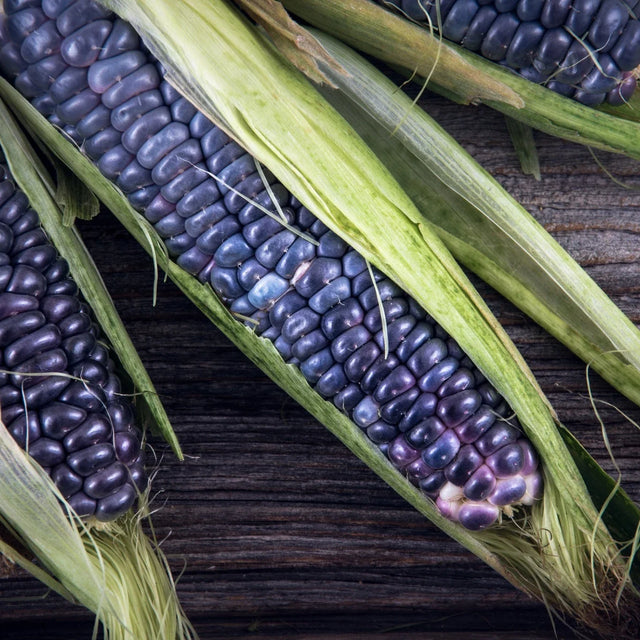
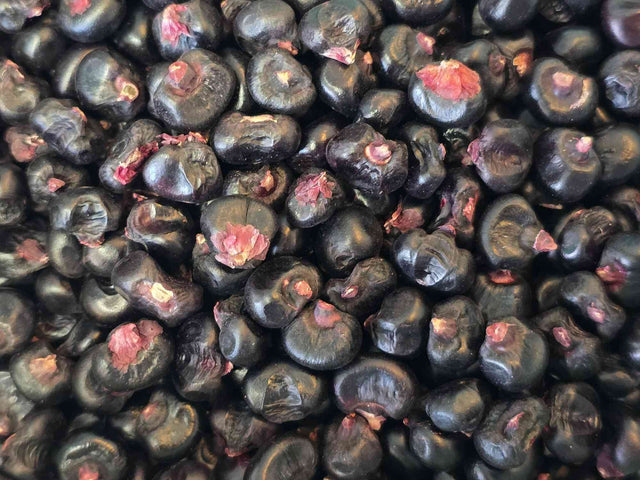
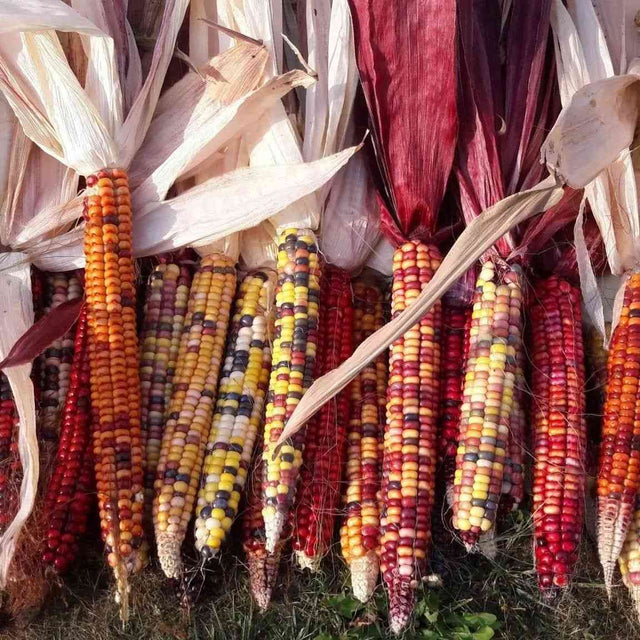
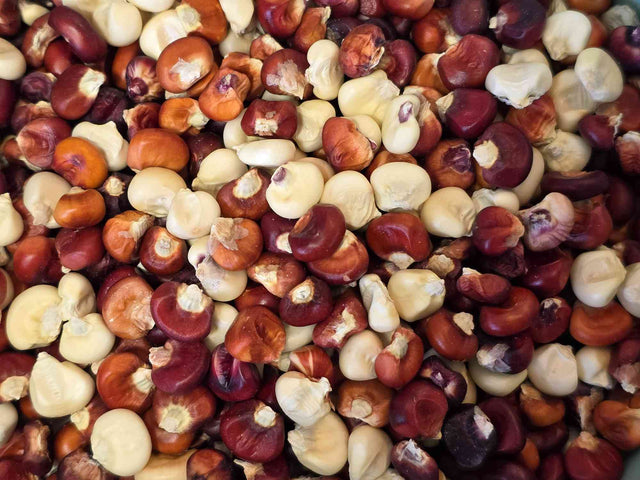
Hopi Blue corn is a dry blue flour corn grown for mature grain, not a blue sweet corn and not a guaranteed popcorn. The kernels are usually softer and mealier than flint corn, which makes the grain easier to mill into flour or fine cornmeal. The blue to purple color comes from anthocyanin pigments, but color intensity, kernel hardness, ear form, maturity, and cooking quality can vary among commercial seed lots sold under the same retail name.
The name carries cultural weight because corn is central to Hopi agriculture and life. That weight requires restraint. A seed-company article should not convert a retail packet into authority over Hopi teachings, describe private or ceremonial uses as marketing copy, or imply that every blue corn is Hopi Blue. The public sources used here are Hopi institutional pages, Hopi-led agricultural research, university publications, and crop science. The guide focuses on what a gardener can responsibly learn: crop type, growing system, climate fit, harvest, milling, seed saving, and the limits of the commercial name.
For gardeners outside the Hopi mesas, the most important lesson is that seed, soil, water, wind, and planting method belong together. Traditional Hopi dry farming uses deep clustered planting in a particular high-desert environment. Copying the visible spacing without the place-specific soil profile, rainfall, seed, and lived knowledge is not the same system. In a humid eastern garden, Hopi Blue should usually be grown in a conventional pollination block with regionally appropriate soil and water management.

What the commercial name does and does not tell you
Hopi Blue is commonly used in the seed trade for a blue flour corn associated with Hopi agriculture. It tells the gardener to expect mature blue or purple dry kernels with a relatively soft, floury endosperm. It does not guarantee that every supplier’s stock is genetically identical, that every kernel will be the same shade, or that a packet has direct, recent provenance from a Hopi family or community seed collection.
Commercial seed populations can drift through small grow-outs, cross-pollination, selection for catalog appearance, or mixing among blue corns. The correct response is not to distrust every packet. It is to maintain an honest record. Save the supplier, lot, year, plant count, isolation method, ear photographs, kernel color, maturity, and kitchen results. If the population changes under your stewardship, say how.
| Retail statement | What it can support | What it cannot support by itself |
|---|---|---|
| Hopi Blue flour corn | A commercial identity for a blue dry-grain flour corn | Proof that the packet came directly from a particular Hopi family or village |
| Blue kernels | Presence of blue-purple pigmentation in this seed lot | Identification of every blue ear as Hopi Blue |
| Flour corn | Expectation of softer endosperm and easier fine milling | A guarantee that every kernel will process identically |
| Associated with Hopi agriculture | Reason to cite Hopi sources and use careful language | Permission to publish private teachings or generic ceremonial claims |
Hopi corn agriculture and the limits of a seed-company guide
The Hopi Tribe’s public natural-resources materials identify dryland farming of corn, squash, beans, melons, and other crops as part of agricultural production on Hopi lands. Hopi-led University of Arizona research describes corn grown under very low annual precipitation and examines how climate change is disrupting rainfall patterns that once supported those systems. Those sources establish that Hopi corn agriculture is living, place-based, and adaptive. It is not a historical costume or a set of tricks detached from land and community.
Michael Kotutwa Johnson’s public research and teaching describe seeds, planting depth, clustered stands, soil moisture, wind, rainfall, and community continuity as one system. Public articles report deep holes, wide spacing, and multiple seeds planted together, but those visible measurements are only part of the knowledge. Soil depth, alluvial moisture, seed adaptation, thinning, field placement, timing, and generations of observation determine whether the method works.
A responsible retail guide can explain the difference between that dryland system and ordinary row planting. It cannot reproduce the full cultural meaning of Hopi corn, speak for Hopi people, or turn public fragments into a universal “Native method.” Readers who want Hopi-specific understanding should begin with Hopi institutions and Hopi farmers, not with a seed-company summary.
Alliance of Native Seedkeepers is Tuscarora- and Nottoway-led. That gives us our own responsibilities to corn and to accurate public education. It does not give us authority to flatten Hopi, Pueblo, Haudenosaunee, Tuscarora, Nottoway, Cherokee, or other distinct agricultural traditions into one story. The respectful approach is to name the nation, name the source, and stop where the public record stops.
Why traditional deep cluster planting is place-specific
University of Arizona reporting on a Hopi-led trial describes bunches of roughly 10 to 12 seeds planted in holes about a foot deep and spaced about six feet apart. Another public account describes eight to ten kernels in deep holes, with the strongest stalks retained. Those dimensions make sense in deep, sandy high-desert soils where roots must reach stored moisture and clustered plants help one another withstand wind.
That is not standard advice for a humid eastern clay or a shallow urban bed. A foot-deep hole in cold, wet soil can deprive seed of oxygen, increase decay, and delay emergence. A widely spaced cluster can reduce pollination if the surrounding block is too small. The same technique changes meaning when the soil profile, rain pattern, wind, and seed are different.
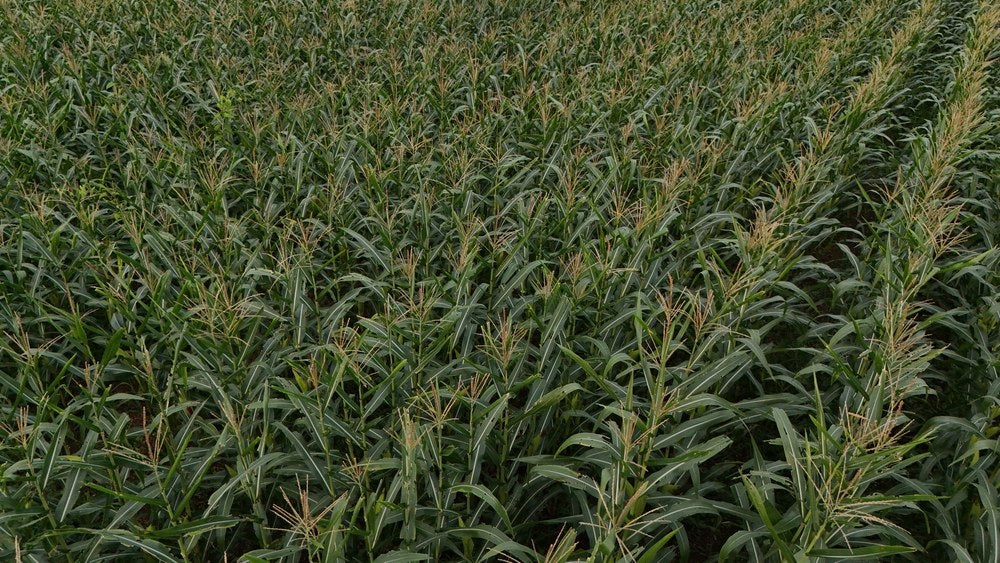
For eastern North Carolina and similar climates, begin with the corn block described later in this guide. Use warm soil, even depth, 8 to 12 inches between final plants, and enough adjacent rows for pollen movement. If you want to study dryland methods, do so as a documented experiment and do not represent the result as Hopi farming. The method belongs to the people and place that developed it.
What blue color means in the kernel and kitchen
Blue and purple maize contain anthocyanin pigments, often concentrated in outer kernel tissues. The amount and exact profile vary by variety and growing conditions. A dark blue ear may grind into blue-gray, lavender, purple, or muted meal depending on the kernel, grind, water chemistry, pH, and processing method.
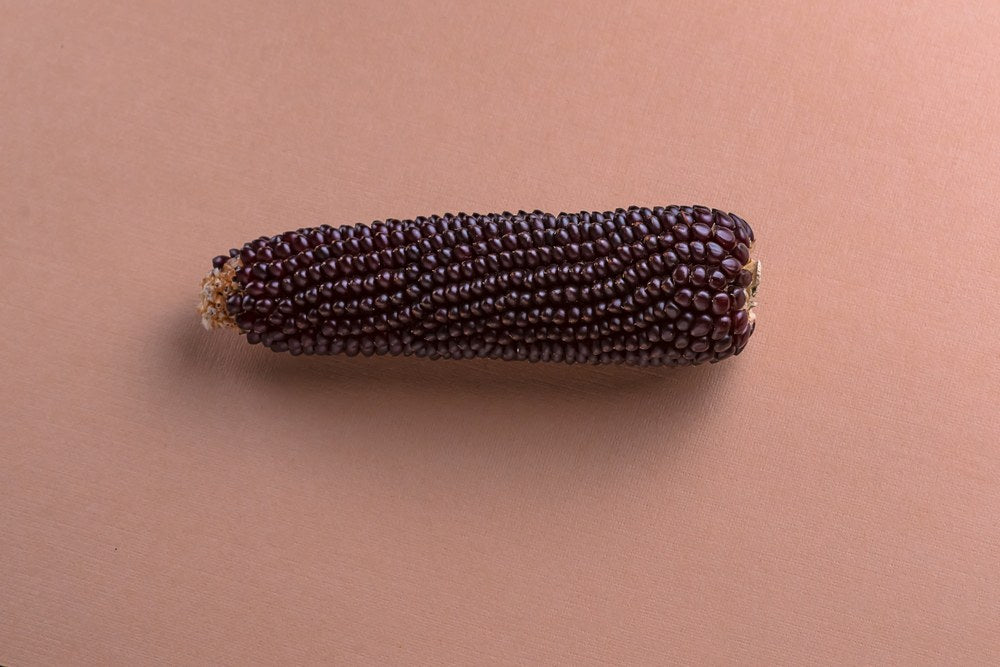
Alkaline cooking changes both the kernel and the pigment. Research on blue maize shows that nixtamalization can reduce total anthocyanin content and shift color while improving other nutritional and processing qualities, including calcium uptake and niacin availability. That means the finished masa or tortilla may not match the raw kernel’s color, and color loss is not automatically evidence that the grain was mislabeled.
Avoid exaggerated health claims. Blue corn is a pigmented whole grain, not a medicine. Research on anthocyanins and phenolic compounds is useful for understanding the grain, but a seed page should not promise disease prevention or imply that one retail variety has a fixed nutrient profile without a laboratory analysis of that lot.
Choose a site and maturity window
Hopi Blue is generally listed as a long-season corn, often around 100 to 110 days, but dry grain may require additional time beyond that estimate. Plant only where the crop can reach full kernel maturity before hard frost. Use full sun and a well-drained bed with deep root volume. Shade from buildings or trees reduces photosynthesis and can delay dry-down.
In the humid Southeast, plant early enough that tasseling avoids the most severe late-summer heat when possible and dry-down begins before the wettest autumn weather. In northern gardens, choose the warmest site, wait for soil near 60°F, and plan for protected indoor drying. In the arid West, water access and wind exposure may matter more than disease, unless the crop is being grown within a place-specific dryland system by someone who carries that knowledge.
Do not assume that a corn associated with arid agriculture will perform without water in every soil. Seed adaptation is specific. A commercial lot increased for years under irrigation may respond differently from a community-maintained dryland population.
Plant Hopi Blue in a useful pollination block
For a conventional home garden, plant in at least four short adjacent rows. Space final plants roughly 8 to 12 inches apart and rows about 24 to 36 inches apart, adjusting for fertility, irrigation, and the vigor of the lot. Plant 1 to 2 inches deep in warm, prepared soil; use the shallower end in heavy soil and the deeper end in sandy soil that dries quickly.
Plant extra seed and thin after emergence. A uniform stand creates a more uniform tassel-silk window. Remove weak seedlings rather than leaving crowded doubles. If birds or rodents pull seed, protect the bed until emergence instead of repeatedly reseeding single gaps over several weeks. Late replacements often contribute little pollen and can create uneven maturity.

A small garden can produce eating grain with fewer plants than a seed-maintenance block, but seed saving requires a broader population. Decide the goal before planting. If only twenty plants fit, treat the grow-out as observation or food production unless you have a controlled-pollination and population-recovery plan.
Manage fertility, heat, and water
Use a soil test and build fertility before planting. Corn needs nitrogen, but it also needs balanced potassium, phosphorus where deficient, organic matter, and a root zone that drains after heavy rain. Excess nitrogen can make tall plants lush and prone to lodging, especially in storm-prone humid climates.
Keep moisture even from rapid vegetative growth through two weeks after silking. Drought before tasseling can reduce the number of potential kernels and delay silks. Drought during pollen shed can break the overlap between tassels and silks. Drought after fertilization can abort tip kernels. Water deeply rather than wetting only the surface.
In humid climates, avoid creating a permanently wet canopy. Apply water at the soil line when possible, space rows for airflow, and rotate away from corn residue when disease pressure builds. The crop’s association with dryland agriculture does not make it immune to leaf blight, rust, smut, stalk rot, or ear rot in a different climate.
Protect purity and complete kernel set
Hopi Blue is wind-pollinated and highly outcrossing. Each silk connects to one potential kernel. Pollen from another corn can change traits in the current ear and will change the genetics of saved seed. Keep sweet corn, popcorn, white flour corn, yellow dent corn, and nearby field corn from shedding pollen onto the Hopi Blue silks when variety identity matters.
Distance requirements depend on the surrounding pollen load. A small neighboring garden is not the same as a hundred-acre field. Time isolation works only when pollen shed and receptive silks do not overlap. Record actual tassel and silk dates rather than trusting planting dates alone.
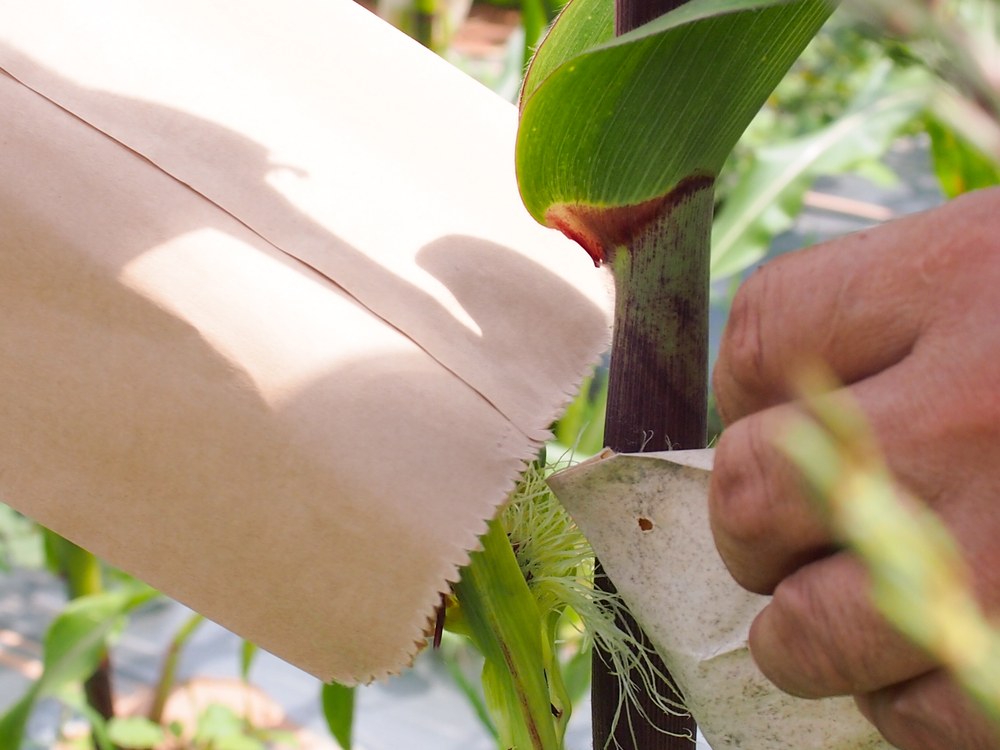
For a small or culturally sensitive seed lot, bagged pollination may be the only honest option. Cover ear shoots before silks emerge. Bag tassels before pollen is released. Mix pollen from many selected plants, apply it to fresh silks, label the cross, and re-cover the ear. Do not let a single male plant become the father of most of the next generation.
Harvest and dry flour corn
Leave the ears until the husks are brown and the kernels are hard. Flour corn can feel softer when ground than flint corn, but mature kernels should still resist a thumbnail. If frost or prolonged rain threatens, harvest mature ears and finish drying under cover with generous airflow.
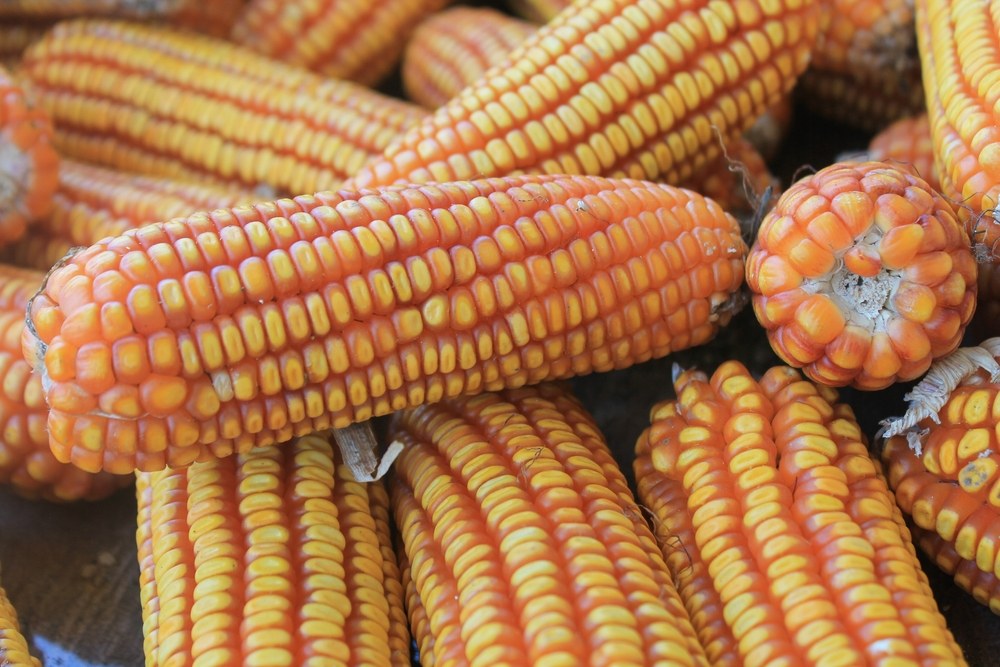
Inspect the tip and base of every ear. Earworm feeding opens the husk to fungi. Discard moldy kernels and do not save seed from diseased ears. Dry selected seed ears separately and label them by family or field section until the final seed lot is assembled.
Shell only when the cob and kernels are dry. Store food grain and seed in clean, insect-resistant containers after moisture has stabilized. Keep a reference sample and a germination sample separate from the eating grain.
Mill and cook the grain by measured trials
Flour corn is valued for a soft starchy endosperm that breaks down more easily than flint corn. That makes it a strong candidate for fine meal, flour, porridge, and nixtamalized foods. The exact performance still depends on the seed lot. Before grinding the whole harvest, mill one pound at two settings and record the amount of coarse bran, fine flour, heat generated, aroma, and cooked texture.
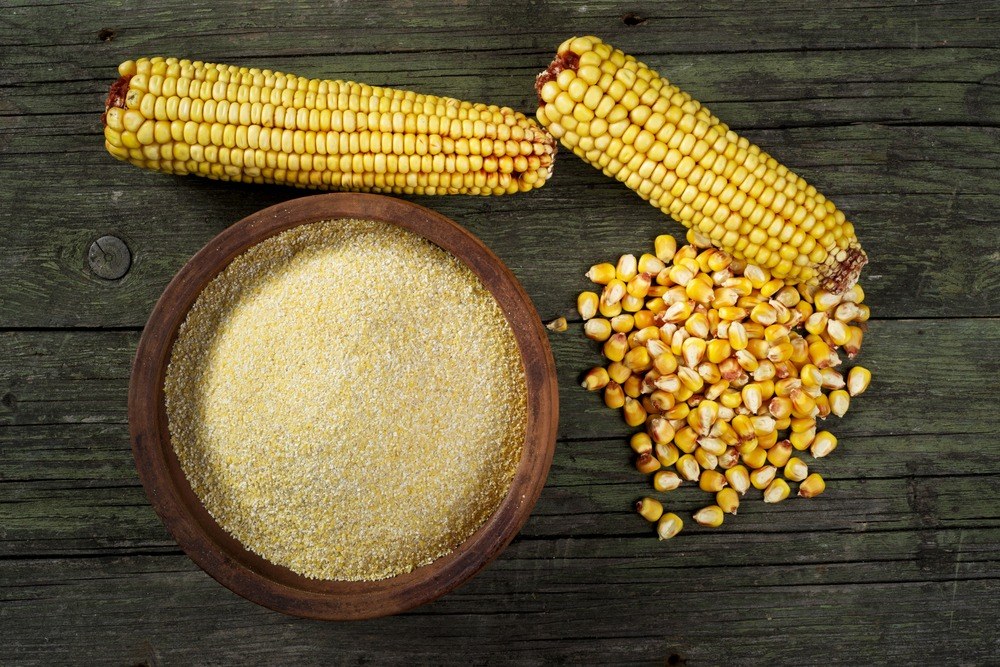
If the goal is masa, test nixtamalization on a small batch. Blue-maize research shows substantial variation among floury landraces in kernel hardness, cooking time, masa texture, tortilla flexibility, and color. A shorter cooking time may be appropriate for a soft kernel, but use a tested process and food-safe calcium hydroxide. Do not infer cooking time from color alone.
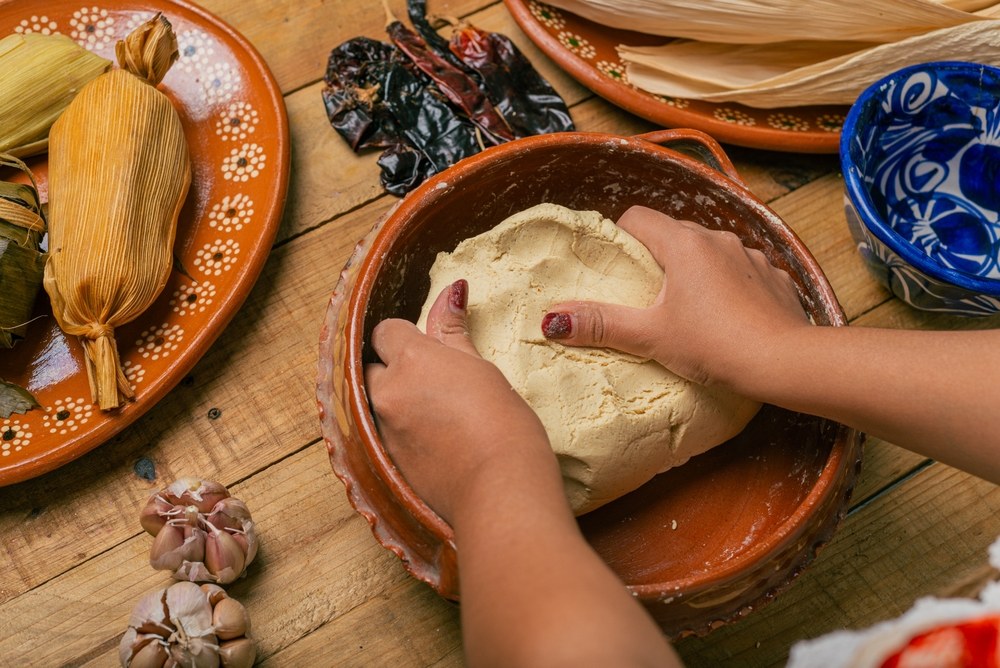
Keep food traditions distinct. A retail phrase such as “traditional dishes” is too vague to be educational and can turn living community foods into marketing decoration. Name the actual process you are teaching, cite the people or institution when appropriate, and do not claim community authority from a commercial packet.
Measure the stand before judging the seed lot
A corn name is not a performance record. Before deciding that a Hopi Blue lot is early, drought tolerant, strongly blue, poorly adapted, or exceptionally productive, measure the stand that produced the result. Begin with the seed itself. Count a fixed sample for a germination test, record the number that develops normal roots and shoots, and compare that result with field emergence. A lot that germinates well indoors but emerges unevenly outdoors points toward soil temperature, planting depth, crusting, birds, rodents, insects, or water distribution rather than weak seed alone.
Map the planted block by row and position. Record the number of seeds planted, emerged seedlings, surviving plants before tasseling, plants that shed pollen, plants that produced silks, harvestable ears, and sound seed ears. Those counts turn a general impression into a population record. Twenty attractive ears can look like a successful season, but they mean something different when they came from 30 plants than when they came from 180.
| Field checkpoint | What to record | Why it matters |
|---|---|---|
| Seven to fourteen days after emergence | Planted kernels, emerged seedlings, gaps, doubles, crusted areas, and pest loss | Separates seed germination from field establishment problems. |
| Knee-high stage | Plant count, weak plants, tillers, leaf color, weed competition, and obvious nutrient patterns | Shows whether the stand is even before reproductive growth begins. |
| First tassel and fifty-percent tassel | Calendar date and number of plants actively shedding pollen | Defines the beginning and center of the pollen window. |
| First silk and fifty-percent silk | Calendar date, silk freshness, and whether silks overlap with pollen shed | Reveals drought delay, maturity spread, and risk of poor kernel set. |
| Dry harvest | Plants harvested, ears per plant, sound ears, mold, insect injury, kernel color range, and ear weight | Connects field performance with usable food and seed. |
Tassel-silk timing deserves special attention in an unfamiliar climate. On the first day anthers begin shedding, shake several tassels over dark paper in the morning and note whether pollen falls. Check fresh silks in the same block. Repeat every two or three days through the main flowering period. If pollen is abundant but silks are late, drought, heat, root restriction, or uneven emergence may be separating the two phases. If silks are present but little pollen is moving, plant number, field shape, storm damage, or maturity spread may be the limiting factor.
Use the record to compare years without pretending that one season defines the population. A humid North Carolina season may reveal leaf disease and slow dry-down that never appear in an arid trial. A dry western season may reveal irrigation timing and hot-wind injury. The honest conclusion is not “this is what Hopi Blue always does.” It is “this documented commercial lot did this in this place, under these conditions, with this plant population.”
Run a controlled kitchen lot evaluation
Do not commit an entire harvest to one food process before testing the grain. Dry the ears completely, shell a clean representative sample, remove insect-damaged or moldy kernels, and divide the grain into labeled trial lots. A practical home evaluation can begin with four 250-gram samples: one for fine meal, one for a coarser grind, one for an alkaline-cooking trial, and one retained as an untouched reference. Keeping equal weights makes the results easier to compare.
For dry milling, clean the mill before the test and record the setting. Weigh the grain before milling and the finished meal afterward. Note how much remains as coarse pieces, how warm the meal becomes, whether the bran separates, how blue or purple the meal appears, and whether the aroma changes as the grain heats. Run a second pass only if the first grind is too coarse. A soft flour corn may move quickly through the mill, but individual kernels within an open-pollinated lot can differ in hardness.
Cook a measured portion of the meal with a recorded water ratio and salt level. Note thickening time, water absorption, aroma, sweetness, bitterness, grit, cohesion, and color after cooking. Blue maize can shift toward gray, purple, lavender, or muted brown depending on pigment location, water chemistry, pH, heat, and processing. That color change is a processing result, not proof that the seed was mislabeled.
For nixtamalization or masa, use a tested food process and food-grade calcium hydroxide. Agricultural lime, masonry lime, and unidentified alkaline products are not food ingredients. Record dry grain weight, lime amount, water volume, heat time, steep time, rinse, hull release, grinding behavior, dough moisture, pressing, cooked flexibility, flavor, and yield. Blue-maize research shows that floury landraces differ in cooking time, dough texture, pigment retention, and tortilla quality, so a recipe that works for one corn may overcook another.
Keep the public description of the trial literal. It is appropriate to say that the lot milled finely, produced a cohesive masa, retained a particular color, or required a certain cooking adjustment. It is not appropriate to call the result a Hopi recipe merely because the seed was sold as Hopi Blue. Food knowledge belongs to people and practice, not to the retail name printed on a packet.
After the trials, choose the crop use from evidence. Reserve the strongest food-performing ears for the use you value, but avoid selecting seed only from the bluest or softest kernels unless narrowing the population is the explicit goal. Field health, maturity, complete ears, dry-down, and family representation still belong in the seed decision.
Maintain a broad, traceable population
Corn loses diversity quickly when seed is saved from too few plants. Organic Seed Alliance recommends at least 200 plants for maintaining a highly outcrossing corn population. If your garden cannot hold that number, do not pretend the risk disappears. Use controlled pollination, save balanced contributions from many families, coordinate a larger increase with a trusted grower, or periodically return to a well-documented source.
Select plants in the field before opening ears. Mark timely emergence, sturdy roots, good stalks, appropriate maturity, disease resistance observed in that season, and ears that remain covered by the husk. Do not select only the darkest kernels. Color is one trait among many, and selecting one shade too narrowly can discard maturity, health, and food quality.
At harvest, keep seed ears separate long enough to compare ear fill, kernel hardness, color range, mold, insects, and family contribution. Combine measured quantities from many sound ears. Record the number of plants and ears represented, the isolation method, the surrounding corn, and the germination result.
Never relabel a changed population as if it were unchanged. If a blue flour corn crossed with another corn, if selection shifted the maturity, or if the stock passed through a severe bottleneck, preserve that information with the seed. Honest provenance is part of seed quality.
Adapt the crop without pretending to recreate Hopi dry farming
| Region or condition | Main concern | Practical approach |
|---|---|---|
| Humid Southeast | Leaf disease, ear rot, storms, slow dry-down | Plant early, use airflow, water at soil level, scout ears, and dry mature grain under cover. |
| Short-season North | Failure to reach hard-kernel maturity | Use the warmest site, plant in warm soil, and plan indoor finishing. |
| Arid irrigated garden | Water timing, wind, salinity | Water deeply at critical stages and protect the pollination block from hot dry wind. |
| Hopi dryland context | Place-specific seed, soil, rainfall, and knowledge | Learn from Hopi farmers and institutions; do not substitute a retail summary for community knowledge. |
| Small urban garden | Too few plants and nearby corn | Grow for food or observation, use hand pollination, or choose a crop that fits the available population. |
Adaptation should be documented rather than romanticized. If the seed lot performs well in eastern North Carolina, record what it did under eastern North Carolina conditions. Do not call that result proof of the full dryland system from which Hopi corn agriculture developed.
Our responsibility when writing about another Native nation
We know from our own Tuscarora and Nottoway work how quickly outsiders can turn a seed name into a story they were never given permission to tell. The answer is not to erase cultural context. The answer is to be precise about whose context it is and what the public sources support.
For Hopi Blue, we can teach that it is a blue flour corn, that Hopi dryland agriculture is living and place-based, that commercial seed lots need provenance records, and that corn requires population, pollination, drying, and selection. We cannot speak for Hopi ceremonial meaning or treat one retail lot as the whole of Hopi corn diversity.
Good seed writing should make the gardener more careful, not merely more impressed. The goal is a healthy crop, an honest record, and respect for the people whose name appears on the packet.
Frequently asked questions
Is Hopi Blue corn sweet corn?
No. It is grown as a dry flour corn. Harvest it after full maturity for meal, flour, nixtamalization trials, and seed.
Is every blue corn Hopi Blue?
No. Blue and purple pigmentation occurs in many flour, flint, dent, and popcorn populations. A named variety requires a documented seed identity.
Does a packet labeled Hopi Blue come directly from Hopi?
Not necessarily. The retail name identifies a commercial population, not a guaranteed direct community provenance. Keep the supplier and lot record.
Should I plant it one foot deep?
Not in most home gardens. Deep clustered planting is part of a place-specific Hopi dryland system. In ordinary humid or irrigated gardens, use locally tested corn planting depth and block spacing.
Why did the blue meal turn gray or purple?
Pigment expression changes with kernel tissues, grind, pH, water, heat, and alkaline processing. A color shift is expected and does not identify the variety by itself.
Can Hopi Blue be popped?
It is a flour corn, not a reliable popcorn. A few kernels may split or expand, but choose a documented popcorn when popping is the primary goal.
How many plants should I grow for seed?
Serious maintenance of open-pollinated corn is commonly based on at least about 200 plants. Smaller plantings need controlled pollination and a plan to avoid a genetic bottleneck.
Can I grow it beside sweet corn?
Only if the flowering periods do not overlap or the crops are isolated. Cross-pollination can change the current ear and the genetics of saved seed.
Is blue corn automatically higher in protein?
No fixed claim should be made without testing the actual lot. Blue corn is valued for pigmentation and food qualities, but nutrient composition varies by genetics and growing conditions.
What is the most respectful way to describe this corn?
Call it a commercial blue flour corn associated with Hopi agriculture, cite Hopi sources, keep provenance records, and avoid unsupported ceremonial or sacred claims.
Sources and further reading
- University of Arizona: Rooted in Tradition, Growing with Science
- Indigenous Resilience Center: Growing Corn in the Desert, No Irrigation Required
- Hopi Tribe Department of Natural Resources
- Indigenous Resilience Center: Can Ancient Seeds Nurture Future Generations?
- Journal of Food Science: Quality Parameters of Masa and Tortillas Produced from Blue Maize Landraces
- Food Science and Biotechnology: Factors Influencing Anthocyanin Loss During Nixtamalization
- Iowa State University Extension: The Birds and Bees of Corn Pollination
- Organic Seed Alliance: Sweet Corn Seed Production Quick Reference
- Organic Seed Alliance: A Seed Saving Guide for Gardeners and Farmers